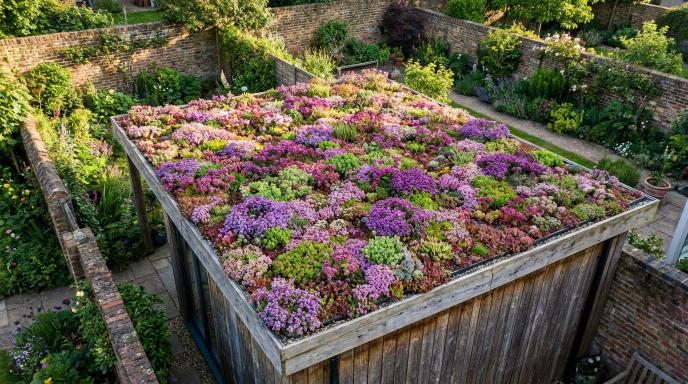
What Are Sedum Living Roofs?
_1.jpeg)
Sedum living roofs use drought-tolerant succulents from the Crassulaceae family, covering 40% of European green roofs per FLL guidelines, creating lightweight (50-150kg/m²) extensive systems ideal for urban retrofits. These extensive green roofs feature substrate depths of 6-15cm and rely on varieties like Sedum acre, spurium, and reflexum. They suit garden rooms and flat roofs in London, aligning with council preferences for low-maintenance urban greening.
Sedum roofs differ from wildflower roofs, which offer higher biodiversity but demand more upkeep. Sedum provides lower maintenance through its hardy nature, while wildflowers attract diverse pollinators. London councils favour sedum for its reliability on retrofits and new builds, per Green Roof Industry Council standards and London Plan Policy G5.
Installation often involves sedum blankets or pre-grown mats, which establish in 2-3 weeks. These mats include plugs or rolls with pre-grown sedum on lightweight substrates, drainage layers, root barriers, and waterproof membranes. This method ensures quick coverage on load-bearing roofs, supporting stormwater management and heat island reduction.
Practical examples include Sedum acre for sunny spots and Sedum spurium for varied conditions. Councils love these eco-friendly roofs for sustainable urban drainage (SUDS) and biodiversity benefits without heavy irrigation needs.
Sedum Plant Benefits
Sedum plants thrive with minimal irrigation (200-400mm annual rainfall sufficient), reducing maintenance costs compared to intensive green roofs. Experts recommend them for low-maintenance roofs in London, where Policy G5 promotes green infrastructure. Their succulent leaves store water efficiently.
A key advantage is drought tolerance via CAM photosynthesis, which stores CO2 overnight. This suits extensive green roofs on rooftops with limited access. Wind uplift resistance comes from their low profile under 10cm, ideal for exposed urban sites.
Sedum offers fire resistance, classified as non-combustible per BR 135 standards, enhancing safety on garden rooms. Seasonal aesthetics include spring yellow flowers from varieties like Sedum reflexum and evergreen foliage year-round. Rapid coverage reaches high levels in the first year via plugs or mats.
- Drought tolerance: Survives dry spells with stored moisture.
- Wind uplift resistance: Stays secure in gusty London weather.
- Fire resistance: Low fuel load prevents spread.
- Seasonal aesthetics: Flowers and foliage boost visual appeal.
- Rapid coverage: Fills substrates quickly for instant greening.
Research suggests evapotranspiration rates of 2-4L/m²/day aid cooling and air purification. Growth progresses from partial cover in year one to near-full by year two, supporting insulation benefits and wildlife habitat in city settings.
Bespoke Garden Rooms
Every Garden Is Unique — Your Room Should Be Too
From awkward L-shaped plots to ambitious multi-use briefs, London's best installers design garden rooms that fit your space and your life perfectly.
London's Green Roof Policies
London Plan Policy G5 mandates green roofs on 100% of new commercial developments over 1,000m² since 2016, covering 130+ hectares by 2023 per GLA data. This policy pushes for urban greening through living roofs, especially sedum-based systems. Councils love green roofs for their role in stormwater management and heat island reduction.
The policy timeline began with encouragement in 2011, shifted to mandatory requirements in 2016, and aligned with net zero targets by 2021. The GLA Green Roof Toolkit sets design standards for sedum green roofs, focusing on low-maintenance roofs and biodiversity roofs. Borough mandates, like Camden's 30% biodiversity net gain, support extensive green roofs on new builds.
Sedum plants thrive in London's climate, offering drought tolerant coverage for eco-friendly roofs. These succulent roofs aid insulation benefits, air purification, and wildlife habitat. London councils promote green roof installation to meet sustainable urban drainage goals.
| Council | Key Mandate |
|---|---|
| Lambeth | Social housing priority for sedum green roofs |
| Islington | 100% on new builds with biodiversity focus |
| Tower Hamlets | Biodiversity roofs mandatory for large developments |
| Camden | 30% biodiversity net gain via living roofs |
| Southwark | Sustainable drainage with sedum blanket systems |
Planning Requirements
_2.jpeg)
London planning requires structural assessments for roofs under 60kg/m² saturated weight, with 85% of approvals using lightweight sedum systems per Historic England guidelines. These checks ensure load-bearing roofs suit extensive green roofs. Sedum mats provide a practical start for garden rooms.
Follow these numbered steps for smooth approval. First, submit a structural engineer's report to BS 6229 standards. Next, install FLL-approved waterproof membrane and root barrier.
- Submit structural engineer's report (BS 6229).
- Install FLL-approved waterproof membrane + root barrier.
- Verify drainage layer (20-40mm).
- Use pre-grown sedum mats (SEDUMAT).
- Obtain BREEAM/LEED credits.
Common pitfalls include insufficient drainage, leading to rejections. Always confirm roof pitch suitability up to 30°. Opt for sedum plugs or mixed sedum varieties like Sedum acre for pollinator friendly coverage.
| Requirement | Specification |
|---|---|
| Pitch | Max 30° |
| Depth | 80-150mm |
| Load | 80-120kg/m² |
Environmental Advantages
Sedum green roofs reduce urban heat islands by 4-5°C per University College London studies, capturing 50-70% airborne particulates versus conventional roofs. These living roofs offer multiple benefits, including temperature reduction from 31°C to 26°C at peak, rainfall retention of 25-60%, PM10 capture at 0.2g/m²/month, and carbon sequestration of 3.5kg CO₂/m²/year. London councils promote them for urban greening and sustainable roofing.
The Barbican Estate case study features a 2.5ha sedum roof installed in the 1980s, demonstrating long-term durability. This extensive green roof supports sedum plants and enhances the local ecosystem. Councils love these low-maintenance roofs for their eco-friendly qualities.
Key mechanisms include thermal regulation, where sedum vegetation and substrates moderate temperatures, and ecological enhancement, fostering biodiversity on rooftops. Green roof installation aligns with London Plan policies like G5 for green roofs. Practical examples include retrofitting existing buildings with pre-grown sedum mats.
These sedum green roofs aid stormwater management and air purification. They fit load-bearing roofs with root barriers and drainage layers. London councils offer incentives for such biodiversity roofs in social housing and public buildings.
Urban Heat Reduction
Green roofs lower building surface temperatures by 30°C (69°C to 39°C) through evapotranspiration, per BRE Trust field studies across 20 London rooftops. Sedum plants from the Crassulaceae family drive this via evapotranspiration cooling, releasing 2-5mm water per day. This mechanism suits extensive green roofs on low-pitch roofs.
The albedo effect plays a role, with sedum surfaces at 0.25 reflectivity compared to 0.90 for asphalt. Thermal mass from green roof substrates stores heat, releasing it slowly. Southwark's 10,000m² sedum roofs cut ambient temps by 2.1°C in the 2022 heatwave.
| Roof Type | Temperature Reduction |
|---|---|
| Extensive sedum | 4°C |
| Intensive | 5.5°C |
Energy modelling shows 15-25% cooling load reduction, aiding energy savings and EPC ratings. Winter insulation benefits extend roof lifespan. Councils like Lambeth endorse these for heat island reduction in dense areas.
Biodiversity Boost
_3.jpeg)
Sedum roofs support 20+ invertebrate species within Year 1, increasing to 40+ by Year 3 per London Biodiversity Action Plan monitoring data. These biodiversity roofs attract pollinators, with bumblebees up 15% and hoverflies up 22%. Birds, including 15 species at Barbican roofs, use them as habitats.
Invertebrates like spiders and beetles thrive on sedum vegetation. Camden's brown roofs, mixing sedum and gravel, host rare solitary bees. This complies with LBAP targets for 30% green coverage.
- Year 1: Sedum dominant, basic colonisers arrive.
- Year 3: Self-seeded natives establish, diversity peaks.
- Year 5: Stable ecosystem with perennials like Sedum acre and Sedum spurium.
Green infrastructure like pollinator corridors connects rooftops. Drought-tolerant succulents need minimal sedum care, making them ideal for rooftop gardens. Islington and Tower Hamlets policies encourage such wildlife habitats in planning permissions.
Regulatory Incentives
London councils offer £50-£150/m² grants, with BREEAM awarding 2-3 credits for sedum roofs covering ≥60% roof area. These incentives make living roofs attractive for garden rooms and sustainable roofing. Councils love green roofs for their role in urban greening and biodiversity roofs.
The GLA Green Roof Fund allocated funds from 2021-2025 to support extensive green roofs with sedum plants. Property owners gain from stormwater management and heat island reduction. BREEAM credits boost certification for eco-friendly roofs and new build green roofs.
ROI for sedum green roofs often shows quick payback through grants. For example, £120/m² installation costs offset by £25/m² annual grants lead to favourable returns. Retrofitting roofs with pre-grown sedum mats enhances insulation benefits and roof lifespan extension.
Application checklists include verifying roof pitch suitability, load-bearing roofs, and green roof substrates. Key 2024 funding windows open in spring for London green roofs. Experts recommend early consultation with green roof architects for compliance.
Council Grants and Subsidies
Lambeth Council pays £100/m² for sedum roofs on social housing (up to £50,000/project), funded 28 projects in 2023 totaling 12,000m². These support low-maintenance roofs and social housing green roofs. Sedum blankets aid drought tolerant plants and pollinator friendly habitats.
Islington offers £120/m² for school green roofs, promoting urban ecology. Tower Hamlets provides £80/m² for biodiversity roofs with sedum plugs. Westminster grants £90/m² for historic retrofits using succulent roofs.
| Council | Grant/m² | Max Award | Eligible Buildings | Application Deadline |
|---|---|---|---|---|
| Lambeth | £100 | £50,000 | Social housing | 31 March 2025 |
| Islington | £120 | £75,000 | Schools | 15 April 2025 |
| Tower Hamlets | £80 | £40,000 | Biodiversity roofs | 30 June 2025 |
| Westminster | £90 | £60,000 | Historic retrofits | 31 May 2025 |
| Camden | £110 | £55,000 | Public buildings | 20 July 2025 |
Follow this step-by-step application process for council incentives. Start with pre-application workshop, submit via Planning Portal, and install within 18 months. Green roof contractors ensure drainage layers and root barriers meet FLL guidelines.
- Attend pre-application workshop with council officers to discuss sedum care and substrate depth.
- Submit detailed plans via Planning Portal, including green roof weight calculations.
- Complete installation within 18 months, with post-project monitoring for performance metrics.
Practical Benefits for Buildings
_4.jpeg)
Sedum roofs extend roof lifespan 20-30 years (50 total vs 20-30 conventional) while improving U-values from 0.25 to 0.18 W/m²K. These living roofs provide strong thermal insulation through their layered structure of sedum plants, substrates, and drainage. London councils promote them for sustainable roofing in urban greening projects.
Acoustic benefits include significant noise reduction, making green roofs ideal for city environments. The vegetation and soil layers dampen sound from traffic and construction. This supports council policies on noise reduction in dense areas like Lambeth and Camden.
Durability improves with UV protection for waterproof membranes, shielded by sedum plants. Roof gardens also boost aesthetic appeal, enhancing property values through biophilic design. Experts recommend them for retrofitting and new builds to meet London Plan green roof guidance.
Energy savings come next, with previews of quantified reductions in heating and cooling needs. These eco-friendly roofs align with BREEAM credits and council incentives for low-maintenance roofs. Practical examples include school and hospital installations for better building performance.
Energy Savings
Green roofs deliver 20% heating savings and 15% cooling savings annually, boosting EPC ratings by 10-15 points per Carbon Trust analysis. Sedum green roofs use evapotranspiration cooling in summer and insulation in winter. This makes them popular for London councils' climate adaptation strategies.
Winter heat loss drops through the thermal mass of substrates and vegetation. Summer heat gain reduces via shade and moisture retention from sedum plants. Roof pitch suitability ensures even performance on low-slope structures common in the city.
| Roof Type | U-value (W/m²K) | Annual kWh/m² | Cost Saving (GBP/m²) |
|---|---|---|---|
| Conventional | 0.25 | 120 | - |
| Sedum Green Roof | 0.18 | 95 | 1.20-2.50 |
| Intensive Roof Garden | 0.15 | 85 | 2.00-3.00 |
Case studies like Millennium Dome retrofits show substantial yearly savings. Payback periods run 8-12 years at typical installation costs. Combine with passive house standards for net zero buildings in Islington or Tower Hamlets.
Stormwater Management Wins
Sedum roofs retain 25-75% rainfall (avg 45%) during 85th percentile events, reducing peak flows by 70% per CIRIA SuDS Manual C753. These living roofs integrate well with sustainable urban drainage systems (SUDS). They handle retention, peak delay, and pollution control effectively.
Green roofs in London councils capture stormwater volumes through their substrates and vegetation. Sedum plants, being drought-tolerant succulents, hold water in drainage layers and release it slowly. This supports SUDS principles for urban greening.
London aims to reduce 30% impervious surfaces via green infrastructure policies. Sedum green roofs contribute by mimicking natural hydrology on rooftops. They delay peaks by 15-30 minutes and remove pollutants like total suspended solids.
Case studies highlight flood prevention in action across the city. Performance data shows consistent benefits from these eco-friendly roofs. Councils love green roofs for their role in climate adaptation and sustainable roofing.
Flood Prevention in London
Southwark's 5,000m² sedum roofs prevented GBP 2.7m flood damage during 2021 events, retaining 180m³ stormwater per Environment Agency modeling. These extensive green roofs use sedum blankets for quick stormwater management. London councils promote them under planning policies.
The Barbican's 2.5ha roof garden retains significant volumes per event, aiding urban flood mitigation. GLA HQ achieves high retention rates with sedum vegetation. Lambeth social housing features blue-green roof hybrids for enhanced performance.
| Rainfall Event | Retention | Runoff Reduction | Example Site |
|---|---|---|---|
| Moderate | High | Significant | Barbican |
| Intense | Moderate | Substantial | GLA HQ |
| Extreme | Variable | Notable | Lambeth Housing |
Design specs include 100mm reservoir capacity and automated overflow for safety. These ensure compliance with London SuDS targets. Low-maintenance roofs like sedum systems support biodiversity and runoff reduction.