What is the 50% Rule?
The 50% Rule under permitted development rights (PDR) limits garden buildings and extensions in London to covering no more than 50% of the original rear garden area, excluding the house footprint. This rule stems from Class E (outbuildings) and Class A (extensions) in The Town and Country Planning (General Permitted Development) (England) Order 2015. It ensures that rear garden development does not overwhelm the land.
The original plot includes the house plus the full rear garden as it stood on 1 July 1948, or when first built if later. Any new garden buildings like sheds, garden offices, or summer houses, plus extensions such as conservatories, must together occupy no more than half that rear garden area. The National Planning Policy Framework (NPPF) at paragraph 129 supports this by emphasising design that respects the plot coverage ratio.
For a practical calculation, consider a 500m² total plot with 300m² house and driveway, leaving 200m² garden; the max build is then 100m². This land coverage limit applies across London boroughs, though Article 4 directions may restrict it further in some areas. Always measure the gross floor area at ground level to check compliance.
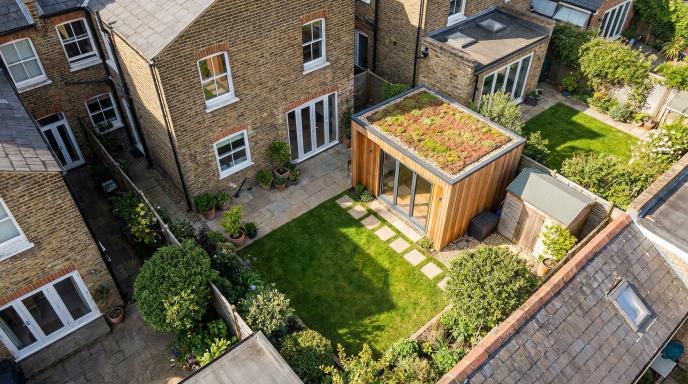
Visualise it like this: the original rear garden is the full shaded area behind the house. The buildable area is only the front half of that garden, leaving the back half free. This prevents overdevelopment and preserves outdoor living space in urban settings.
Bespoke Garden Rooms
Every Garden Is Unique — Your Room Should Be Too
From awkward L-shaped plots to ambitious multi-use briefs, London's best installers design garden rooms that fit your space and your life perfectly.
Why Does It Exist in London?
London's 50% Rule prevents garden land from becoming 100% hard landscaping. It preserves green space amid high urban density. This rule ensures rear garden development maintains some natural areas.
The rule stems from efforts to balance permitted development rights with environmental protection. In dense suburbs, it stops garden extensions from covering the entire plot. Councils enforce it to protect amenity for residents and wildlife.
Experts recommend checking London Plan Policy G6 on open space before any build. This policy supports the 50% limit to safeguard outdoor living space. For example, a garden office or shed must leave half the area as grass or planting.
Practical advice includes calculating plot coverage ratio early. Use your title deeds to measure the original garden boundary. This avoids planning permission refusals and neighbour objections.
Planning Policy Origins
The 50% rule originated in the 1947 Town and Country Planning Act to prevent urban sprawl into private gardens. It evolved through updates to control garden building coverage. Early laws aimed to keep residential garden rules intact.
The 1977 GPDO introduced coverage limits for outbuildings. The 1988 version clarified garden boundaries for permitted development. By the 2015 Order, it defined the 'original' plot precisely.
1948 TCPA set basic planning controls. 1977 GPDO added floor area limits. 1988 clarified curtilage rules. 2015 Order refined 50 percent coverage. NPPF paragraph 129 states development should not result in unacceptable loss of amenity. London Plan 2021 Policy D8 reinforces this for London planning laws.
Case law like Skerritts of Nottingham v SSETR (2000) established curtilage definition. Apply this when planning a garden studio or conservatory. Always confirm your planning compliance with the local authority.
Measuring Your Buildable Area
Calculate buildable area by measuring your property's original rear garden (excluding house, driveway, pre-1948 extensions) then applying the 50% rule.
This approach ensures compliance with London planning laws for permitted development rights on garden building coverage. Focus on the plot as it stood in 1948 to avoid including later additions like garages or conservatories.
Start with accurate measurements to determine your plot coverage ratio. Common pitfalls include overlooking side garden areas or non-garden land, which can reduce your allowable floor area limit.
- Obtain the title plan from the Land Registry for £3 to confirm current boundaries.
- Check historic Ordnance Survey maps for 1948 outlines, distinguishing original from post-war changes.
- Subtract the house footprint, driveway, and any pre-1948 structures from the total garden area.
- Halve the remaining original garden size to find your maximum buildable land area.
For example, a 1960s Hounslow semi with a 250m² garden might yield 125m² max build after deducting a 20m² driveway expansion. Always verify with a professional surveyor before submitting planning applications.
Original vs Current Plot Size
Use Land Registry title plan (£3 online) and 1948 Ordnance Survey maps to determine 'original' garden boundaries excluding post-1948 extensions.
This step clarifies the 50% coverage under UK planning regulations, preventing overestimation of rear garden development potential. Post-1948 additions, such as a 1960s garage, count toward existing coverage and cannot be included.
- Order Title Register and Title Plan from LandRegistry.gov.uk for £3 to map your property precisely.
- Access free historic OS maps via the National Library of Scotland to identify 1948 boundaries.
- Hire an RICS surveyor (£400-800) for boundary confirmation, especially in disputed areas.
- Calculate: (Original garden area minus house footprint) divided by 2 equals buildable area.
A common error is including extensions like a side garden garage, which reduces your allowance for new garden outbuildings such as sheds, offices, or summer houses. Consult local authority rules, like Hounslow council, for borough variations on permitted development.
London-Specific Variations
While national permitted development rights set the 50% rule, 22 London boroughs apply Article 4 directions removing rights entirely in 35% of wards. This creates varied London garden building opportunities across the city. Local authority rules often limit garden extension and plot coverage ratio.
Check your property's status using borough-specific tools on the Planning Portal. For instance, Hounslow council rules maintain the 50% coverage except on designated streets. Always verify rear garden development potential before planning a garden office or summer house.
Article 4 directions target conservation areas and high streets to preserve character. They require full planning permission for any garden building coverage. Consult your local council early for side garden building or garden outbuilding ideas.
Experts recommend confirming your planning position for peace of mind. Neighbour consultation helps avoid disputes under the Party Wall Act. Sustainable designs with biodiversity net gain improve approval chances in urban settings.
Borough Differences
Hounslow allows 50% coverage borough-wide except Article 4 streets; Kensington & Chelsea removes PDR garden rights from 75% of properties. These London planning laws affect garden plot ratio and floor area limit. Always confirm via the Planning Portal's 'My development doesn't have permitted development rights' tool.
BoroughArticle 4 CoverageMax Coverage AllowedPlanning Portal Checker Hounslow10% streets50%Planning Portal tool Wandsworth22%30-50%Planning Portal tool Kensington75%Full permission neededPlanning Portal tool Islington45%Case-by-casePlanning Portal tool
In Wandsworth PDR areas, aim for under 30% for smoother approvals on garden studio projects. Kensington limits push projects toward architect garden design with full submission. Islington's approach suits custom conservatory garden plans but demands early dialogue.
Practical steps include a topographical survey for buildable land area calculations. Factor in eaves height limit and boundary distance rules. For non-habitable buildings like a storage shed, stick to Class E outbuildings where rights apply.
Exceptions and Special Cases
Listed buildings, conservation areas, and Article 4 directions override the 50% rule, requiring full planning permission for any London garden build. These restrictions protect heritage and character in sensitive areas. Property owners must check local rules early.
Flats lack permitted development rights for garden outbuildings, so no PDR garden extensions apply. Green Belt land faces strict limits on rear garden development to preserve openness. Always consult your local authority for plot coverage ratio checks.
Other cases include tree preservation orders or eco-friendly outbuildings needing extra surveys. For example, a garden office in restricted zones may require neighbour consultation. Submit a planning enquiry to your local authority to confirm status.
Experts recommend starting with a surveyor report garden to assess title deeds plot covenants. This avoids neighbours objections and ensures compliance with London planning laws. Timely checks prevent costly planning refusal appeals.
Listed Buildings
Grade II listed properties require Listed Building Consent alongside planning permission regardless of 50% coverage. This applies to any work within the domestic garden curtilage. Alterations must preserve the original character.
- Check the listing status using official resources.
- Submit LBC and full PP applications together.
- Design features like matching brickwork to stay in keeping.
A real-world example is Chiswick House gardens, where all outbuildings are prohibited within the curtilage. Even small shed garden structures trigger heritage reviews. Owners often need an architect garden design for approval.
Process timelines extend due to Historic England input on garden buildings guidelines. Factor in structural engineer report for foundations. This ensures building regulations approval aligns with heritage restrictions.
Conservation Areas
London's conservation areas often have Article 4 directions removing garden outbuilding PDR entirely. These zones prioritise aesthetic harmony over standard permitted development rights. Check your property's status first.
Use your council's interactive map to confirm coverage. In Hampstead CA, for instance, no side garden building or rear structures over 2.5m tall qualify. This protects views and right to light.
- Submit detailed plans showing garden plot ratio.
- Include materials like timber cladding matching locals.
- Address overshadowing rules and daylight rights.
- Appeal refusals to the Planning Inspectorate within six months.
If refused, expect a fee for appeals and prepare evidence of compliance. Councils like Hounslow enforce strict local authority rules. A landscape architect can help design sustainable garden build options that fit.
Getting Planning Permission
Submit a full planning application (£578 for householder applications) with architect drawings showing 50% coverage compliance. This ensures your London garden build respects the plot coverage ratio. Local authorities check against London planning laws and permitted development rights.
Hire a RIBA architect first for detailed drawings (£2k-5k). They confirm your garden extension or garden office fits within the 50% rule. Drawings must detail rear garden development, eaves heights, and boundary distances.
- Hire a RIBA architect (£2k-5k for drawings) to design compliant garden outbuildings.
- Submit via the Planning Portal (£578 fee) with all supporting documents.
- Await 8-week determination (90% meet statutory timescale).
- Address typical conditions like materials and landscaping before starting work.
Expect neighbour consultation during review. Conditions often cover overshadowing rules, biodiversity net gain, and sustainable garden build features. Use the template cover letter below to strengthen your case.
Template Cover Letter for Planning Application
Dear Planning Officer,
I am applying for householder planning permission to build a garden studio on my property at [Address]. The design adheres to the 50% rule, covering less than half the original garden land.
Drawings show gross floor area within limits, with eco-friendly outbuildings like solar panels and permeable paving. This garden transformation enhances outdoor living space without impacting neighbours' right to light.
Please find enclosed architect plans, site plans, and a structural engineer report. I welcome any queries.
Yours sincerely, [Your Name]
Customise this template with specifics like plot ratio calculation and Party Wall Act notices. It highlights compliance with UK planning regulations and permitted development rights.
Common Violations and Penalties
Building beyond 50% coverage risks an Enforcement Notice requiring demolition. In 2023, London councils issued 2,847 such notices for garden building coverage breaches. Property owners often face unexpected costs from these actions.
Common violations include including old structures like a 1970s garage in plot coverage ratio calculations, which led to a £20k fine in Richmond in 2022. Multiple small garden outbuildings such as sheds or offices can total over the 50% rule limit. Using non-original plot measurements from outdated plans also triggers issues under London planning laws.
Penalties for permitted development breaches carry unlimited fines and demolition orders. Owners can appeal to PINS, where many cases succeed with proper evidence. Always check your planning position before starting rear garden development.
A Hounslow case study shows a 65m² overbuild resulting in a full demolition order. The owner ignored garden plot ratio and faced enforcement after neighbour complaints. This highlights the need for accurate gross floor area surveys in suburban garden builds.
Alternatives to Full Extensions
Prefab garden offices under 2.5m eaves height often fit the 50% rule and avoid full planning. These structures count as non-habitable buildings under permitted development rights. They provide flexible space without eating into your garden building coverage.
Options like raised decks or modular pods expand your outdoor living space. They comply with London planning laws by staying within plot coverage limits. Choose based on your rear garden development needs and budget.
A hybrid setup combines elements, such as a 30m² office with 20m² decking, to remain compliant. This approach maximises usable area while respecting the 50 percent coverage. Consult local authority rules for your borough, like Hounslow council rules.
These alternatives boost property value increase and kerb appeal. They suit garden transformation projects without triggering full planning permission. Always check permitted development rights for PDR garden structures.
| Option | Max Size | Planning Needed | Cost | Example |
|---|---|---|---|---|
| Raised Deck | Unlimited | No | £8k | IKEA decking |
| Sipson Summerhouse | 3x4m | No (<50%) | £12k | Sipson model |
| Modular Pod | 4x3m | Prior approval | £25k | Dunster House |
| Garden Office | 3x3m | No (under 2.5m eaves) | £15k | Timber clad prefab |
| Hybrid Deck + Office | 30m² office + 20m² deck | No | £35k | Compliant combo |
Raised Decks for Extra Space
Raised decks offer unlimited size under permitted development if elevated properly. They avoid floor area limits since decks do not count towards the 50% rule. Ideal for sloped garden build or creating level platforms.
Install composite decking for low maintenance in London clay soil. Ensure boundary distance rules and balustrade height for safety. Add features like hot tub platforms without planning.
Summer Houses and Sheds
Summer houses like the Sipson model fit within 3x4m under 50% coverage. They qualify as garden outbuildings with no planning if under eaves height limits. Use for storage sheds or playrooms.
Check neighbour consultation and party wall act rules. Opt for eco-friendly outbuildings with solar panels garden additions. These enhance outdoor living space sustainably.
Modular Pods and Prefabs
Modular pods around 4x3m need prior approval but stay compliant. Brands like Dunster House deliver flat pack options quickly. Perfect for garden office or home gym setups.
Ensure insulation requirements and fire safety garden standards. Integrate bifold doors garden for seamless indoor-outdoor flow. Budget for groundwork costs in urban gardens.
Hybrid Solutions
Hybrid designs blend 30m² office with 20m² decking for full compliance. This maximises buildable land area without exceeding half plot buildable limits. Great for property extension London alternatives.
Combine with permeable paving for SUDS compliant drainage. Add wifi garden office features for remote work. Verify with a surveyor report garden for plot ratio calculation.
Next Steps for Homeowners
Step 1: Order Land Registry title plan (£3) and measure original garden using OS 1948 maps. This confirms your plot coverage ratio under the 50% rule. Accurate boundaries prevent disputes over garden building coverage.
Follow a clear action checklist to check permitted development rights for your London garden. Each step builds evidence for your planning compliance. Total timeline spans 4-6 weeks.
Use the free Planning Portal PDA Checker tool early. It flags Article 4 directions and local restrictions. Combine with council maps for Hounslow council rules or similar borough variations.
Costs stay low: title plan at £3. Hire professionals for surveys to avoid neighbours objections. This process proves <50% gross floor area compliance.
Action Checklist
Start with the Land Registry title plan to define your domestic garden curtilage. Cross-reference with historic maps for original garden land use. This establishes baseline 50 percent coverage.
- Order Land Registry title plan (£3, 2 days processing). Use it to measure rear garden development limits.
- Commission RICS measured survey (£500). Get precise topographical survey for sloped gardens or London clay soil.
- Check Article 4 direction on council interactive map. Verify conservation area rules or tree preservation order impacts.
- Hire architect for feasibility study (£1,500). Develop concept design ensuring eaves height limit and boundary distance rules.
- Submit plans proving floor area limit under Class E outbuildings.
Track progress weekly to meet the 4-6 week timeline. Consult estate agent advice on property value increase from compliant garden office or summer house.
Timeline and Costs Breakdown
Week 1: Secure title deeds plot and run Planning Portal PDA Checker. Identify permitted development hurdles like green belt gardens.
| Step | Duration | Cost |
|---|---|---|
| Land Registry title plan | 2 days | £3 |
| RICS measured survey | 1 week | £500 |
| Article 4 check | 1 day | Free |
| Architect feasibility | 2 weeks | £1,500 |
Total 4-6 weeks fits UK planning regulations. Budget £2,143 for peace of mind on garden extension. Factor in party wall act notices for side garden building.
Experts recommend early neighbour consultation. Address right to light or overshadowing rules upfront. This smooths retrospective permission if needed.
Frequently Asked Questions
What is 'The 50% Rule: How Much of Your London Garden Can You Actually Build On?'
The 50% Rule: How Much of Your London Garden Can You Actually Build On? refers to a key guideline in UK planning policy, specifically under the National Planning Policy Framework (NPPF) and London borough regulations. It generally allows you to build extensions or outbuildings covering up to 50% of the original garden area (as it existed on 1 July 1948 or when the house was first built), provided it doesn't exceed permitted development rights. Always check with your local council for site-specific rules.
Does 'The 50% Rule: How Much of Your London Garden Can You Actually Build On?' apply to all London properties?
No, 'The 50% Rule: How Much of Your London Garden Can You Actually Build On?' does not apply universally. It's primarily for houses under permitted development rights in England, including London. It excludes flats, maisonettes, properties in conservation areas, Areas of Outstanding Natural Beauty (AONB), or listed buildings. Inner London boroughs like Westminster or Kensington may have stricter rules, so verify with your local planning authority.
How do you calculate the 50% under 'The 50% Rule: How Much of Your London Garden Can You Actually Build On?'?
To apply 'The 50% Rule: How Much of Your London Garden Can You Actually Build On?', measure the original curtilage (land around the house, including garden) as it was on 1 July 1948 or at first construction. You can cover up to 50% of that area with buildings (excluding the original house footprint). Use historical Ordnance Survey maps or council records; subtract any pre-existing extensions from available coverage.
What counts as 'building on' the garden in 'The 50% Rule: How Much of Your London Garden Can You Actually Build On?'?
Under 'The 50% Rule: How Much of Your London Garden Can You Actually Build On?', 'building on' includes new extensions, outbuildings, sheds, garages, or pools with hard landscaping. It excludes the original house, driveways, paths, patios, decking (if under 30cm high), or greenhouses/green features. Incidental buildings like small garden storage may be exempt if they meet size criteria.
Can I exceed the 50% limit in 'The 50% Rule: How Much of Your London Garden Can You Actually Build On?'?
You might exceed 50% under 'The 50% Rule: How Much of Your London Garden Can You Actually Build On?' with full planning permission from your local council, rather than relying on permitted development. Prior approval or full applications are common in London for larger projects. Factors like design, neighbour impact, and biodiversity net gain influence approval.
What are common mistakes with 'The 50% Rule: How Much of Your London Garden Can You Actually Build On?'?
Common pitfalls in 'The 50% Rule: How Much of Your London Garden Can You Actually Build On?' include miscalculating the original curtilage, ignoring shared gardens in terraced houses, overlooking height/boundary rules (e.g., 2.5m eaves), or building without prior approval notice. Retrospective applications can lead to enforcement notices or demolition orders—consult a planning expert or use the Planning Portal before starting.