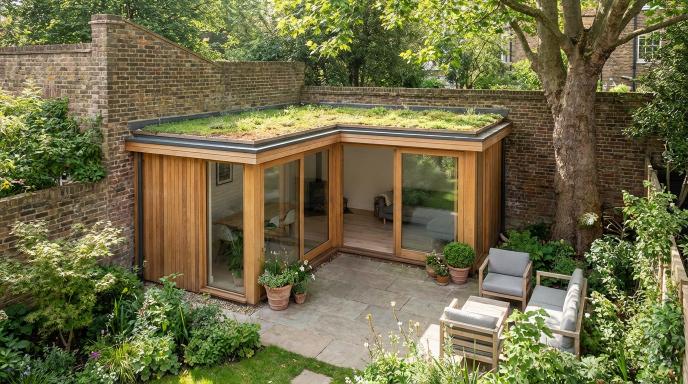
Understanding L-Shaped Garden Rooms
L-shaped garden rooms transform underutilised corner spaces in London gardens into functional extensions. These modular or bespoke structures fit perfectly into 90° corner plots, often with a typical 3m x 3m footprint. They turn awkward garden shapes into valuable living areas.
One key advantage is maximising irregular plots. L-shaped designs wrap around boundaries to provide more floorspace than rectangular options. This makes them ideal for compact London property gardens.
Another benefit comes from bi-fold doors that create private outdoor rooms. They enable seamless indoor-outdoor flow for garden studios or offices. Privacy improves while natural light floods the space.
Experts note higher ROI with these L-shaped garden rooms. For example, an Islington townhouse added 25sqm of office space in a 4x4m corner. This boosted usability without major disruption.
Benefits of Corner Space Utilization
Corner garden rooms deliver more usable space than standard rectangular designs by wrapping around existing boundaries. They excel in awkward corner spaces common in London backyards. This approach suits irregular garden spaces perfectly.
Key benefits include strong space efficiency. A 3x3m corner structure yields 9sqm, compared to 6sqm from a rectangular fit. Natural division creates two zones automatically, like a garden office London and relaxation area.
- Privacy screening blocks neighbour views completely for secluded outdoor living spaces.
- Cost savings arise from efficient use of materials, often lower than expanding rectangular builds.
- Visual appeal from modern angular designs enhances garden room aesthetics.
Consider a Croydon garden transformation: a 12sqm dead corner became a home gym and office. Bi-fold doors and insulated walls added multi-functional value. Such before-and-after changes highlight corner space utilization.
Bespoke Garden Rooms
Every Garden Is Unique — Your Room Should Be Too
From awkward L-shaped plots to ambitious multi-use briefs, London's best installers design garden rooms that fit your space and your life perfectly.
Assessing Your London Garden Layout
Accurate measurement prevents planning rejections in London boroughs. Start by evaluating your L-shaped garden to identify awkward corner spaces. This step ensures your garden room design fits within permitted development limits.
Many Victorian London gardens feature irregular L-shapes that suit corner garden structures. Check height restrictions at 2.5 metres and the rule covering no more than 50% of the garden area. These guidelines apply to most UK garden buildings without full planning permission.
Use free tools like Google Earth Pro for an initial aerial survey of your irregular garden spaces. A laser measure such as the Bosch GLM 50 C offers precise readings. Always factor in the 1 metre boundary setback from the Party Wall Act 1996 to avoid disputes.
Common pitfalls include ignoring slopes or neighbouring views in compact garden designs. Document everything to support garden room planning permission applications. This approach maximises your outdoor living space potential.
Measuring Awkward L-Shaped Areas
Use laser distance measurers like the Leica DISTO D2 for high accuracy in L-shaped layouts. These tools handle up to 100 metre ranges with minimal error. They simplify assessing awkward corner spaces in London property gardens.
Follow these steps for precise measurements:
- Mark the corner apex with spray paint to define the L-shape clearly.
- Measure both legs separately using a 30 metre tape for spans under 10 metres.
- Calculate the hypotenuse with Pythagoras via a free app like GeoGebra.
- Document with smartphone 360° photos using apps like Google Street View.
- Create a scale diagram in SketchUp Free at 1:50 scale for garden room installation planning.
A frequent error is ignoring fence gradients, which require adjustments like 15 centimetres per metre of slope. Verify measurements twice for space-saving garden rooms. This ensures your bespoke garden rooms fit perfectly.
Integrate findings into designs for modular garden buildings or prefab garden rooms. Consider features like bi-fold doors for corner space utilization. Accurate data supports options from garden office London to multi-functional garden rooms.
Design Principles for L-Shaped Spaces
L-shaped designs follow flow zoning principle, allocating space to primary function and circulation. This approach suits awkward corner spaces in London gardens. It creates balanced L-shaped garden rooms that feel spacious.
Core principles include golden ratio proportions with leg lengths in a 1:1.618 ratio. This mimics natural harmony for corner garden structures. Designers draw from Frank Lloyd Wright's corner pavilion designs for seamless integration.
Next, use 45° sightlines to enhance visual flow in L-shaped layouts. Pair this with modular grid systems based on 600mm bays for flexible, space-saving garden rooms. Tools like Chief Architect Premier or free Live Home 3D help plan these precisely.
For example, the Kew Gardens pavilion employs a 2.4x3.9m L-shape. This captures optimal light in compact garden designs. Apply these in your garden office London or multi-functional garden rooms.
Maximising Light and Flow
Position corner glazing to capture more daylight than central placements. This tactic boosts natural light in L-shaped garden rooms. It transforms awkward corner spaces into bright outdoor living spaces.
Use these four tactics for better flow. First, install frameless corner glass like Schüco AWS 90.SI for low U-values. Second, add clerestory windows such as Velux GGL CK04 to diffuse light evenly.
- Third, fit light shelves that bounce daylight deeper into the room for even illumination in garden studios.
- Fourth, place bi-fold doors on the short leg, like Origio 6000 series with up to six panels, to open up panoramic views.
Test setups with free DIALux lux calculator for uniform lighting. A Wandsworth gym case study features a 4.2m glass corner achieving consistent brightness. Ideal for corner garden gym or garden bar corner in London backyards.
Planning Permissions in London
Permitted Development rights allow many L-shaped garden rooms in London without full planning permission. Structures under 2.5m eaves height and covering no more than 50% of the garden often qualify. This applies to awkward corner spaces in compact London gardens.
Check your garden coverage by measuring existing sheds or outbuildings first. Exceed 50% land coverage, and you need approval. Height limits are strict at 2.5m for flat roofs or 4m for pitched roofs within 2m of boundaries.
London has unique rules due to Article 4 Directions in boroughs like Camden and Islington. These remove some Permitted Development rights to protect local character. Always verify with your council for corner garden structures.
Use a simple flow to assess needs: Is height over 2.5m? If yes, full planning is required. For quick checks, councils offer pre-application tools that take about 10 minutes.
Compliance Checklist for L-Shaped Garden Rooms
Follow this compliance checklist to ensure your L-shaped garden room fits Permitted Development rules. It helps utilise awkward corner spaces legally in London property gardens.
- Height: Keep under 2.5m for flat roofs or 4m for pitched roofs if within 2m of boundary.
- Coverage: Limit to 50% of garden area, subtracting existing sheds from calculations.
- Rooms: Avoid bedrooms or bathrooms on boundaries to prevent neighbour issues.
- Materials: Match your house with brick or cedar cladding for visual harmony.
Experts recommend consulting neighbours early for garden room planning permission. Document measurements with photos for council submissions.
Decision Flow for Planning in London Gardens
This simple flow chart guides decisions for modular garden buildings in irregular garden spaces. Start with basic checks to avoid delays in garden room installation.
| Step | Question | Action |
|---|---|---|
| 1 | Over 2.5m eaves height? | Full planning needed |
| 2 | Exceeds 50% coverage? | Apply for permission |
| 3 | In Article 4 borough? | Check local rules |
| 4 | Matches house materials? | Proceed if yes |
For bespoke garden rooms, use this flow before design. It maximises corner space utilization while staying compliant in London backyard solutions.
Practical example: A garden office London in an L-shaped layout fits under limits with a flat roof at 2.4m. Always confirm via council pre-app advice for peace of mind.
Material Choices for UK Climate
UK exposure zone 4 demands U-values ≤0.18W/m²K for year-round use (Building Regs Part L 2021). This ensures L-shaped garden rooms in awkward corner spaces stay comfortable in London's damp weather. Choose materials that resist moisture and wind.
Cedar, like Western Red, offers a 50-year life in TRADA durability class 1. It suits cedar clad garden rooms for natural aesthetics in compact garden designs. Composite options such as Treadek cost around £120/m² and need little upkeep.
Render like K-rend K1 at £90/m² provides a smooth finish for white render garden looks on bespoke garden rooms. Aluminium systems, including Reynaers CS 68 at £250/m², excel in durability for aluminum garden rooms. Stress SIPs panels such as Kingspan OSB3 with R-6.5 for insulated garden rooms.
The Hampton Court show garden used larch SIPs for thermal bridge-free performance. These panels fit modular garden buildings perfectly in irregular garden spaces. They support garden office London setups with efficient heating.
Weather-Resistant Options
Composite materials reduce maintenance to 1 hour/year vs 20+ for timber (BS 8417 durability testing). They protect low maintenance garden buildings in London property gardens from rain. Rank options by lifespan and cost for smart choices.
Top is Accoya timber at 50 years and £180/m², ideal for sustainable garden rooms. Next, fibreglass GRP lasts 60 years at £220/m², great for eco-friendly garden pods. Powder-coated aluminium offers 40 years at £200/m² for modern garden architecture.
- Accoya timber: 50yrs, £180/m² – acetylated for stability in L-shaped layouts.
- Fibreglass GRP: 60yrs, £220/m² – seamless for corner garden structures.
- Powder-coated aluminium: 40yrs, £200/m² – sleek for black framed garden rooms.
- HardiePlank fibre cement: 30yrs, £110/m² – tough for grey garden room cladding.
- VMZINC: 100yrs, £300/m² – premium for contemporary garden rooms.
CWCT TN25 tests confirm water penetration resistance. Suppliers like Green Retreats at £25k and Dunster House at £18k offer these for garden room costs London. Pick for your corner plot garden to maximise space.
Construction Process Overview
Complete build takes 5-7 days for 12sqm L-shape using modular SIPs (Green Retreats average timeline). This quick timeline suits London gardens with tight schedules and limited access. L-shaped garden rooms transform awkward corner spaces efficiently.
Ground preparation starts with a 150mm thick concrete pad to meet NHBC Chapter 4.4 standards for stability. Costs for foundations run at £150/m², ensuring a solid base for corner garden structures. Proper groundwork prevents settling in irregular garden spaces.
SIPs assembly uses structural insulated panels for speed and insulation in bespoke garden rooms. Roofing follows with 1.2mm EPDM for flat roof garden rooms, common in compact garden designs. Final stages include glazing, electrics, and cladding for a fully functional garden office London.
Here's an 8-step timeline for typical installation:
- Day 1: Groundworks - Excavate and pour £2k concrete pad, 150mm thick.
- Day 2-3: SIPs assembly - Erect panels with crane hire £400.
- Day 4: Roofing - Install EPDM 1.2mm membrane.
- Day 5: Glazing/electrics - Fit bi-fold doors garden and wiring.
- Day 6: Cladding - Apply cedar clad garden rooms or composite options.
- Day 7: Internal fit-out - Add garden room flooring, lighting, and heating.
| Component | Cost per m² | Notes |
|---|---|---|
| Foundations | £150/m² | Concrete base garden per NHBC 4.4 |
| SIPs | £250/m² | Insulated garden rooms core |
| Labour | £400/day | Garden room installation teams |
This process maximises space-saving garden rooms in London property gardens. Professional garden installers handle permits like garden room planning permission swiftly.
Critical Path Diagram
The critical path ensures no delays in L-shaped garden room builds. Groundworks must finish before SIPs assembly, as panels need a level base. This sequence keeps the project on track for 5-7 day completion.
Visualise the flow: Day 1 foundations lead directly to Days 2-3 SIPs, then parallel tasks like roofing and glazing on Days 4-5. Cladding and fit-out follow sequentially to avoid rework. Experts recommend this for prefab garden rooms in awkward garden shapes.
Dependencies include crane access for modular garden buildings, vital in narrow London backyards. Weather can impact outdoor stages, so schedule during dry periods. This path supports multi-functional garden rooms like corner garden gyms or garden bars.
For corner plot gardens, prioritise electrics early for garden room heating and WiFi. Adhering to NHBC standards minimises risks in home extension London projects. Result: a seamless garden room installation transforming irregular spaces.
Budgeting and Cost-Saving Tips
London L-shaped garden rooms average £185/sqft installed according to the 2023 Homebuilding & Renovating survey with 1,247 respondents. This figure covers garden room installation in awkward corner spaces of London gardens. Costs vary based on size, materials, and features for these space-saving garden rooms.
Planning a budget starts with understanding typical price ranges for L-shaped layouts. Basic models suit compact garden designs, while premium options add luxury to corner plot gardens. Review the breakdown below to match your needs for a garden office London or multi-functional garden room.
| Package | Size | Cost | Key Features |
|---|---|---|---|
| Basic | 9sqm | £22k | Modular kit, flat roof, gravel base, LED lighting |
| Mid-range | 12sqm | £32k | SIPs panels, bi-fold doors, basic electrics, insulated walls |
| Premium | 15sqm | £48k | Bespoke design, pitched roof, skylights, full plumbing |
Owners of corner garden structures often see an 8% annual return through rental at around £800/mo. This makes L-shaped garden offices or studios a smart home extension London. Factor in long-term value when budgeting for irregular garden spaces.
Save money with smart choices in garden room design. Opt for modular garden buildings or DIY elements to cut expenses on prefab garden rooms. These tips help maximise garden potential in London property gardens without compromising quality.
Top Cost-Saving Strategies
Implement these seven practical savings for your L-shaped garden room. They target common expenses in garden room costs London. Focus on materials and timing to lower overall garden room prices UK.
- Choose modular kits to save 25% or £4k compared to bespoke garden rooms.
- Select a flat roof garden room for 12% less than pitched roof garden rooms.
- Install LED lighting at £200 instead of £800 for halogen in garden room lighting.
- Use a gravel base at £40/m² over concrete at £150 for garden room foundations.
- Handle self-install electrics if Part P exempt under 10 circuits for garden room electrics.
- Bulk buy SIPs direct for insulated garden rooms and sustainable garden rooms.
- Schedule off-peak build from Oct-Mar for 15% savings with professional garden installers.
These steps work well for awkward garden shapes like L-shaped layouts. For example, a gravel base suits decking around garden rooms in narrow garden solutions. Combine them for maximum impact on your garden transformation.
Interior Layout Ideas
L-shaped interiors enable zones within zones layouts, fitting office and gym in 12sqm spaces. This approach suits awkward corner spaces in London gardens. Garden room design maximises every inch of irregular shapes.
Follow zoning ratios of 55% primary use, 25% secondary, and 20% circulation. Primary zones hold key functions like desks or equipment. Secondary areas add flexibility for storage or lounging.
Common layout types include office/gym splits, kitchen/lounge L-shapes, and yoga/meditation with storage. Tools like RoomSketcher help visualise plans. For example, a Chiswick 3.5x3.5m L-shaped garden room uses the long leg for an office with desk and Zoom setup, short leg for Peloton gym space.
These multi-functional garden rooms turn corner garden structures into productive outdoor living spaces. Adapt for garden office London needs or home extension ideas. Customise to fit compact garden designs.
Multi-Functional Zoning
Sliding room dividers create 3-in-1 spaces: office in the morning, gym in the afternoon, cinema in the evening without losing floor area. This works well in L-shaped garden rooms. Zoning keeps functions separate yet accessible.
Four practical zoning strategies suit space-saving garden rooms. Use an IKEA RÅSKOG trolley as a mobile divider for small shifts. Origami folding screens offer stylish, foldable separation in 10sqm layouts.
- Track glazing systems with door tracks provide semi-permanent divides for 12sqm rooms.
- Built-in cabinetry creates fixed zones in larger 15sqm bespoke garden rooms.
A Balham garden pod case study shows switching from office to bar via a 2.4m bi-fold internal partition. Furniture layouts stack desks against walls in the long leg, freeing the short leg for exercise mats or seating. Integrate garden room lighting and electrics for seamless transitions.