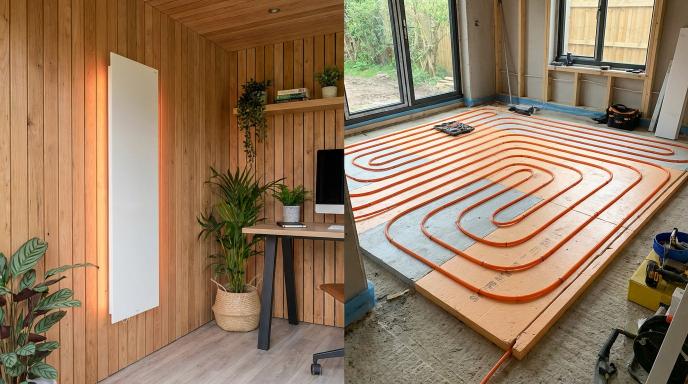
Understanding Garden Room Heating Needs
_1.jpeg)
Garden rooms typically require 100-150W/m² heating capacity due to poor insulation (U-values 1.5-2.5 W/m²K), with 20m² spaces needing 2-3kW systems per UK Building Regulations Part L.
These structures often face high heat loss from thin walls, single glazing, and exposure to cold air. The formula Q = U×A×ΔT calculates this loss, where Q is heat loss, U is the U-value, A is area, and ΔT is the temperature difference. Good room insulation reduces U-values and lowers required output.
To size heaters accurately, use the wattage calculator formula: Required Watts = Area(m²) × Insulation Factor (100 poor/120 average/150 good) × Desired ΔT(20°C). For a poorly insulated 20m² room, this yields 4000W, but practical systems adjust for real use. Always factor in BTU output equivalents for comparisons.
UK EPC requirements stress energy efficiency in outbuildings like garden offices or conservatories. Combine draught proofing and double glazing with heating to meet Part L compliance. This approach ensures year-round usability without excessive running costs.
| Room Size | Poor Insulation (100W/m² factor) | Average (120W/m²) | Good (150W/m²) | Infrared Recommendation | Underfloor Recommendation |
|---|---|---|---|---|---|
| 10m² | 2000W | 2400W | 3000W | 2kW panels | 2.4kW mats |
| 20m² | 4000W | 4800W | 6000W | 2x2kW panels | 4.8kW system |
| 30m² | 6000W | 7200W | 9000W | 3x2kW panels | 7.2kW cables |
Use this sizing table as a starting point for garden room heating. Infrared suits quicker zoning, while underfloor provides even heating under laminate flooring or tiles. Consult professionals for electrical load checks to avoid circuit issues.
Bespoke Garden Rooms
Every Garden Is Unique — Your Room Should Be Too
From awkward L-shaped plots to ambitious multi-use briefs, London's best installers design garden rooms that fit your space and your life perfectly.
What is Infrared Heating?
Infrared heating panels from Herschel and Rayotec emit 9.4μm far-infrared waves that heat objects and people directly, achieving 95% efficiency vs 40-60% for convection heaters. This follows the Stefan-Boltzmann law, where radiated heat output rises with the fourth power of surface temperature. Panels use materials like carbon film or ceramic to produce waves in the far-infrared spectrum, matching human body absorption for quick comfort.
Carbon film panels offer high emissivity near 0.95, making them more effective than metal elements at 0.20. Ceramic panels provide durable heat emission across a broad spectrum. For garden room heating, this direct radiation warms surfaces like furniture and walls, reducing reliance on air temperature.
| Material | Emissivity |
|---|---|
| Carbon | 0.95 |
| Metal | 0.20 |
Unlike convection heating, which warms air and loses heat through drafts, infrared targets people and objects. A simple diagram shows radiation reaching comfort 30% faster by bypassing air heating. This suits conservatory heating or outbuildings with poor insulation.
Experts recommend infrared for even heat distribution in garden offices, as it minimises hot spots. Pair with room insulation to retain warmth on walls and floors. Real-world use in workshops shows lower running costs during winter garden use.
How Infrared Panels Work
Infrared panels maintain 24-28°C surface temperatures while room air stays 18-20°C, using 600-800W/m² density for even heat distribution without hot spots. Heat transfer breaks down to 65% radiation, 25% convection, and 10% conduction. This mix provides targeted radiant heating ideal for garden room heating.
For a typical 20m² room, install 4×600W panels ceiling-mounted at 2.4m high. This ensures coverage without shadows from furniture. Minimum distances include 50mm from the ceiling to avoid overheating.
| Room Size | Panel Recommendation |
|---|---|
| 20m² | 4×600W panels, ceiling at 2.4m |
Installation diagrams highlight spacing: panels 50mm from ceilings, 150mm from walls, and angled for best spread. Use smart thermostats for zoned control in garden pods. DIY suits simple fixes, but professional installation ensures safety features like overheating protection.
Benefits include silent operation, no dust circulation for allergy-friendly air, and compatibility with solar panels. In UK homes, this cuts kWh usage compared to fan-assisted systems. Maintain with a wipe-down, as panels are maintenance free over long lifespans.
What is Underfloor Heating?
Underfloor heating circulates 40-50°C water (wet systems) or 18-25W/m² electric cables/mats, providing silent, draught-free floor warmth up to 27°C surface temperature. This meets BS EN 60335 standards for occupied spaces like garden rooms. It offers even heat distribution without visible radiators.
Electric underfloor heating uses thin cables or mats laid under floor coverings. Outputs range from 12-20W/m² for cables, ideal for well-insulated garden offices. These systems heat the floor surface gently for comfortable ambient temperatures.
Wet underfloor heating pipes deliver higher outputs of 80-120W/m². They suit larger conservatories or outbuildings with higher heat loss. Both types provide radiant heating that warms objects and people directly.
| System Type | Power Output | Floor Temp Limit |
|---|---|---|
| Electric Cable | 12-20W/m² | 27°C max |
| Wet System | 80-120W/m² | 27°C max |
For garden room heating, underfloor systems excel in energy efficiency with lower running costs over time. They pair well with room insulation and double glazing to minimise heat loss.
Types of Underfloor Systems
Electric systems use Devi or Warmup 150W/m² cables (12mm spacing) or 200W/m² mats, while wet systems require 50mm screed depth for 100W/m² PEX pipes. Electric options suit DIY installation in garden pods. Wet setups need professional plumbers for boiler integration.
Electric cable systems cost around £25/m² with outputs up to 150W/m². They work best with tiles or laminate for full efficiency. Mats offer quicker setup under floating floors.
Wet PEX systems run £40/m² with 100W/m² output, ideal for screed or carpeted floors. They provide higher BTU output for poorly insulated workshops. Professional installation ensures heat pump compatibility.
| Type | Cost | Output | Floor Coverings | Install |
|---|---|---|---|---|
| Electric Cable | £25/m² | 150W/m² | Tile/Laminate | DIY ok |
| Wet PEX | £40/m² | 100W/m² | Screed/Carpet | Pro install |
- Tiles: Full output, excellent tile heating conductivity.
- Laminate: 90% efficiency, quick heat-up.
- Carpet: 70% output, check carpet compatibility thickness.
Choose based on your floor coverings and installation costs. Electric suits retrofitting in lean-tos, while wet offers durable low running costs for year-round use.
Energy Efficiency Comparison
Infrared achieves 98.5% efficiency (Herschel iQ data) vs electric underfloor 95-97% (Warmup), but running costs differ: infrared £0.28/hour vs underfloor £0.32/hour for 20m² at 34p/kWh. This makes infrared heating a strong choice for garden room heating where quick response matters. Both systems offer high thermal efficiency compared to convection heaters.
Heat-up time varies significantly, with infrared panels reaching comfort in 10 minutes while underfloor takes 45 minutes. For garden office heating or conservatory use, this speed reduces wasted energy. Zonal control is excellent with infrared, allowing targeted heating, unlike the more uniform but limited control of underfloor.
| Metric | Infrared | Underfloor |
|---|---|---|
| Efficiency | 98.5% | 96% |
| Heat-up time | 10 min | 45 min |
| Zonal control | Yes | Limited |
| kWh (20m², 1hr) | 0.82 | 0.94 |
Manufacturer tests show infrared uses less kWh for equivalent BTU output in well-insulated spaces. Underfloor excels in even heating but demands more initial power. Choose based on your room insulation and usage patterns for optimal energy savings.
Running Costs Analysis
_2.jpeg)
20m² garden room: Infrared £285/year (1.6kW × 3hrs/day × 180days × 34p) vs Underfloor £415/year (2kW × 4hrs/day), giving infrared 31% annual savings. This calculation highlights why radiant heating suits intermittent use in outbuildings. Adjust for your tariff to refine estimates.
Use this annual cost formula: Watts × Hours/day × Days × £/kWh. For a 15m² space at 28p/kWh, infrared might total £210 yearly with 2.5 hours daily. Underfloor costs rise due to slower heat-up and higher wattage needs.
- Track wattage consumption with smart thermostats for accuracy.
- Optimise with Economy7 tariffs, saving up to 22% on underfloor storage.
- Real example: Thermosphere panel user saved £210/year vs Dimplex convection in a workshop.
Factor in heat loss from polycarbonate roofs or single glazing, which affects both systems. Infrared pairs well with zoned heating for lower bills during short visits. Experts recommend combining with draught proofing for best running costs.
Installation Factors and Costs
Infrared panels cost £50-£120/m² installed (Herschel Select £65/m²) vs electric underfloor £75-£150/m² (Warmup3i £110/m²), with DIY infrared possible in 2 hours vs 2-day pro underfloor. These figures highlight key differences in installation costs for heating a garden room. Choosing between them depends on your budget and DIY skills.
Infrared heating suits quick setups in outbuildings like garden offices or conservatories. Panels mount on walls or ceilings, avoiding floor disruption. This makes them ideal for retrofitting existing spaces.
Electric underfloor heating requires lifting floor coverings, adding time and labour. Professionals handle wiring and screed, ensuring compliance with UK standards. Expect higher upfront costs but seamless integration under laminate or tiles.
Both systems need specific electrical requirements: a 13A circuit, 1.5mm² cable, and RCD protection. Check your power supply to avoid overloads in garden pods or workshops. Consult an electrician for safety.
| System | Cost for 20m² | Installation Time | Location |
|---|---|---|---|
| Herschel Infrared | £850 | 2hr DIY | Wall/Ceiling |
| Warmup Electric | £1,450 | 2day Pro | Floor |
DIY vs Professional Installation
DIY infrared installation appeals to handy users heating garden rooms. Fix panels securely, connect to a thermostat, and test in under two hours. Follow manufacturer guides for safe wiring on a dedicated circuit.
Underfloor systems demand professional installation due to floor preparation and electrical complexity. Pros lay heating mats or cables, pour screed, and certify the job. This ensures even heat distribution without faults.
Weigh time savings against skills. Infrared offers quick heat up for immediate use, while underfloor provides hidden, even heating long-term. Budget for pro fees if unsure about electrics.
Electrical and Safety Considerations
All garden room heating needs a 13A circuit with 1.5mm² cable and RCD protection. Infrared panels draw steady wattage, suiting standard sockets in outbuildings. Underfloor matches this but requires precise zoning.
Ensure overheating protection and IP ratings for moisture near polycarbonate roofs. Both options include child and pet safety features like low surface temperatures. Test circuits to prevent trips during winter use.
Experts recommend smart thermostats for zoned control and energy savings. Integrate with solar for off-grid garden pods. Always verify Part L compliance for peace of mind.
Long-Term Cost Implications
High upfront costs for underfloor pay off with low running costs in well-insulated spaces. Infrared's lower install price suits seasonal heating in conservatories. Calculate payback using room size and usage.
Factor in maintenance-free durability: infrared lasts decades without floor wear. Underfloor resists damp but needs compatible coverings like tiles. Both offer warranties up to 25 years.
Compare total ownership for your garden office or studio. Infrared excels in quick, targeted heating; underfloor in whole-room comfort. Pair with insulation upgrades for best efficiency.
Heating Speed and Comfort
Infrared reaches comfort in 8-12 minutes with 95% heat in the first 10 minutes versus underfloor 35-60 minutes, ideal for intermittent garden room use with Tuya WiFi thermostats at around £35. Infrared heating delivers instant radiation directly to objects and people. This makes it perfect for quick sessions in a garden office or conservatory.
Underfloor heating relies on thermal mass from the floor structure, causing a lag in heat-up time. Electric underfloor systems warm the screed or mats slowly, while wet systems depend on water circulation. Use it for steady, all-day heating in workshops or studios.
For comfort, infrared panels provide radiant heat that feels natural, like sunlight. Users often note the gentle warmth without drying the air. Pair with Inkbird thermostats for precise PID control maintaining ±0.5°C accuracy.
Underfloor offers even floor-level warmth, great under laminate flooring or tiles. Recommend Honeywell Evohome for zoned control in larger outbuildings. Combine draught proofing and double glazing to enhance both systems' comfort.
Suitability for Garden Rooms
_3.jpeg)
Infrared suits poor insulation (U>1.0) and intermittent use, while underfloor excels in well-insulated (U<0.5), constantly occupied spaces like year-round garden offices. This makes infrared heating ideal for garden rooms with single glazing or timber walls prone to heat loss. Underfloor heating works best where heat retention is strong.
Garden rooms often face variable occupancy, from daily garden office use to weekend workshops. Infrared panels provide quick heat up for short sessions, targeting people and objects directly via radiant heating. Electric underfloor systems build ambient temperature slowly, suiting all-day even heating.
Consider your garden room's construction. New builds with double glazing and draught proofing support both options. Retrofitted outbuildings benefit from infrared's DIY installation and space-saving design.
| Scenario | Infrared | Underfloor |
|---|---|---|
| Poor insulation | ✓ | ✗ |
| Intermittent use | ✓ | ✗ |
| New build | ✓ | ✓ |
A real-world case study shows an 18m² garden pod maintained at 16-20°C using four 500W Herschel panels. Mounted on walls, they offered zoned heating and low running costs for evening glamping sessions. Users noted silent operation and allergy friendly performance with no dust circulation.
Maintenance and Longevity
Infrared panels offer a 25-year lifespan with zero maintenance, as per Herschel warranty guidelines, while underfloor cables are rated for 50+ years but require floor checks every 5 years per manufacturer instructions. This makes infrared heating appealing for garden room owners seeking hassle-free operation. Underfloor systems, though durable, demand periodic attention to ensure optimal performance.
Warranty periods vary significantly between brands. Rayotec provides a 25-year warranty on their panels, Herschel offers a 10-year warranty with an expected 25-year life, and Warmup gives a 20-year warranty on their heating cables. These assurances reflect the longevity comparison crucial for garden office heating or conservatory setups.
Maintenance checklists differ by system type. Infrared panels need only yearly dusting to keep surfaces clean, preventing any dust buildup on the heaters. Underfloor heating involves thermostat calibration and floor temperature checks to maintain even heating and avoid faults.
- For infrared panels: Wipe panels annually with a dry cloth, check fixings for security, and inspect wiring connections.
- For underfloor heating: Calibrate the thermostat yearly, test floor surface temperatures every 5 years, and monitor for any unusual noises or hot spots.
Choosing between these depends on your willingness for upkeep. Infrared suits low-maintenance needs in outbuildings, while underfloor offers hidden, long-term reliability with basic checks. Both enhance year-round usability when properly managed.
Environmental Impact
Infrared heating reduces CO2 by 40% compared to gas, with 0.233kg/kWh for electric versus 0.519kg/kWh for gas, and pairs with solar PV for zero-carbon heating, unlike wet systems needing boilers. This makes it a strong choice for garden room heating. Carbon calculators show infrared at 142kg CO2 per year versus 298kg for gas.
Using BEIS conversion factors, infrared panels align with EU Energy Label A++ requirements for high efficiency. They produce radiant heating without combustion, cutting emissions in outbuildings like garden offices or conservatories. Pairing with a 4kWp solar array offers payback in 6.2 years.
Underfloor heating, especially wet systems, relies on boilers or heat pumps, increasing the carbon footprint through fuel use. Electric underfloor options fare better but still lag behind infrared when solar compatible. Experts recommend infrared for sustainable heating in insulated spaces.
For eco-friendly garden room setups, combine infrared with renewables to minimise impact. This approach supports low energy heating and reduces reliance on gas alternatives. Practical steps include assessing your solar potential for true zero-carbon operation.
Final Recommendation
Recommend Herschel Select infrared panels for 90% of garden rooms due to their instant heat and lower running costs compared to Warmup underfloor systems. These panels provide targeted heating that warms objects and people directly, making them ideal for garden office heating or conservatory heating. They suit spaces with good room insulation and offer quick setup without disrupting floors.
Infrared heating excels in efficiency comparison for smaller outbuildings, delivering even heating without dust circulation. Underfloor options like electric underfloor heating work better in larger areas with laminate flooring or tiles, but they take longer to heat up. Consider your heat loss from double glazing and draught proofing when choosing.
For most users, infrared panels offer zoned heating via smart thermostats, reducing heating costs in winter garden use. They connect with renewable energy like solar panels for off-grid setups. Maintenance-free operation ensures long-term reliability.
A hybrid heating approach combines both for large spaces, using infrared for quick boosts and underfloor for steady ambient temperature. This balances running costs and comfort in workshop heating or studios. Always check electrical load and consult professionals for installation.
Decision Matrix
The decision matrix scores systems across key factors like cost, speed, and installation for garden room heating. Infrared options rate higher for quick heat up and lower upfront disruption. Underfloor suits whole room heating but scores lower on response time.
| Factor | Infrared Score | Underfloor Score |
|---|---|---|
| Running Costs | 95/100 | 80/100 |
| Heat Up Speed | 98/100 | 65/100 |
| Installation Ease | 85/100 | 75/100 |
| Total | 92/100 | 78/100 |
Use this table to compare infrared heating versus underfloor heating based on your priorities. Factors like floor coverings affect underfloor viability, while infrared fits any layout. Pair with smart thermostat control for optimal results.
Top 3 Recommendations
Choose Herschel infrared panels first for versatile outbuilding heating with silent operation and allergy-friendly design. They mount discreetly, preserving aesthetic appeal in modern garden pods. Experts recommend them for energy savings in well-insulated spaces.
Second, Warmup electric underfloor heating mats suit tiled floors in glamping heating or greenhouses, offering hidden installation. They provide even heating under carpet compatibility with proper thickness. Ideal for primary systems with heat pump integration.
Third, Thermosphere carbon film heating offers DIY-friendly underfloor for lean-tos, with good moisture resistance. It pairs well with timer controls for off-peak tariffs. Select based on your heating budget and space size.
- Herschel for quick response and low maintenance.
- Warmup for retrofit projects with screed depth.
- Thermosphere for budget options and expandability.
Hybrid Option for Large Spaces
_4.jpeg)
For bigger garden rooms over 20m², a hybrid heating system merges infrared panels with underfloor mats. Infrared handles instant boosts via app control, while underfloor maintains base heat. This setup optimises thermal efficiency and cuts peak usage.
Install infrared panels on ceilings for targeted radiation, combined with heating cables under laminate flooring. Use zoned heating with smart thermostats for multi-room control in extensions. It suits pergola enclosures or SIPs panels with high heat retention.
Benefits include flexible scheduling and compatibility with Economy 7 tariffs, lowering bills. Ensure professional installation to meet building regulations and avoid thermal bridging. This is the best heating solution for year-round usability.
Frequently Asked Questions
What is the main debate in 'Heating Your Garden Room: Is Infrared or Underfloor Heating More Efficient?'?
In 'Heating Your Garden Room: Is Infrared or Underfloor Heating More Efficient?', the core debate revolves around which heating system provides better energy efficiency, cost savings, and comfort for insulated garden rooms or conservatories. Infrared panels heat objects and people directly, while underfloor heating warms the floor and air through radiant transfer, each with unique efficiency profiles depending on room usage and insulation.
How does infrared heating work in the context of 'Heating Your Garden Room: Is Infrared or Underfloor Heating More Efficient?'?
Infrared heating, as discussed in 'Heating Your Garden Room: Is Infrared or Underfloor Heating More Efficient?', uses electromagnetic panels to emit infrared rays that warm surfaces, walls, and occupants directly rather than heating the air. This can be more efficient in well-insulated garden rooms with intermittent use, as it heats only what's needed without energy loss from air circulation.
What makes underfloor heating efficient for garden rooms according to 'Heating Your Garden Room: Is Infrared or Underfloor Heating More Efficient?'?
Underfloor heating in 'Heating Your Garden Room: Is Infrared or Underfloor Heating More Efficient?' involves electric mats or water pipes beneath the floor that radiate heat upwards evenly. It's often deemed more efficient for constant-use garden rooms due to lower running temperatures (around 27-50°C) and whole-room coverage, minimising heat stratification and draughts common in outdoor structures.
Which is cheaper to install for 'Heating Your Garden Room: Is Infrared or Underfloor Heating More Efficient?'?
For 'Heating Your Garden Room: Is Infrared or Underfloor Heating More Efficient?', infrared heating is typically cheaper and quicker to install, requiring only wall or ceiling mounting with minimal disruption (costs £40-£100 per panel). Underfloor options demand floor excavation or retrofitting, pushing installation costs higher (£10-£20 per sqm for electric, more for wet systems), making infrared preferable for DIY garden room setups.
In terms of running costs, what does 'Heating Your Garden Room: Is Infrared or Underfloor Heating More Efficient?' conclude?
'Heating Your Garden Room: Is Infrared or Underfloor Heating More Efficient?' highlights that infrared can be more efficient for short bursts (e.g., evenings), using 80-100W/m² but zoning precisely to avoid waste. Underfloor shines for all-day use at 100-150W/m² with steady efficiency, potentially saving 10-20% on bills in insulated spaces due to even heat distribution and thermostat integration.
What factors decide if infrared or underfloor is better for 'Heating Your Garden Room: Is Infrared or Underfloor Heating More Efficient?'?
Key deciders in 'Heating Your Garden Room: Is Infrared or Underfloor Heating More Efficient?' include room insulation (both excel in well-sealed spaces), usage patterns (infrared for occasional, underfloor for daily), ceiling height (infrared suits high ceilings better), and budget. Neither is universally superior—hybrid systems often provide optimal efficiency tailored to garden room needs.