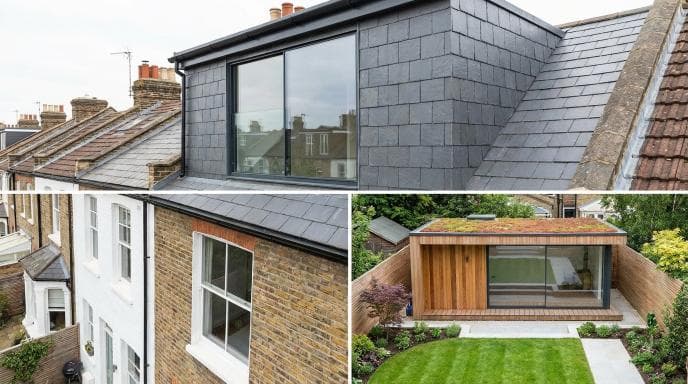
When a London home runs out of usable space, two routes tend to dominate the conversation: building a detached garden room at the bottom of the garden, or extending the house itself with a rear or side return. They answer the same need for more room, but they are very different projects in cost, planning, build time, and the way they change how you live in the property. Choosing between them is less about which is better in the abstract and more about which suits your plot, your budget, and what you actually want the new space to do.
A house extension grows the footprint of the main dwelling. A rear extension pushes out into the garden, a side return fills the dead alley alongside a Victorian terrace, and a wraparound combines both. The result is an integrated room that flows from the existing house, served by the same heating, plumbing, and entrance. A garden room is the opposite philosophy. It is a separate, fully insulated building set away from the house, reached by stepping outside, and that physical separation is the whole point for anyone who wants to leave their work or their workout behind a closing door.
Planning Permission: The Decisive Difference
Planning is usually where the two diverge most sharply. A garden room normally falls under Permitted Development as an outbuilding incidental to the house, which means no formal planning application is required provided it stays within the published limits on height, position, and footprint. The Planning Portal sets out the outbuilding rules for England in detail, and the headline figures are a maximum height of 2.5 metres within two metres of a boundary, a single storey, and no more than half the garden covered by buildings.
A house extension can also be Permitted Development, but the allowances are tighter and the conditions more numerous, covering how far it projects, eaves and ridge heights, materials matching the existing house, and side-facing windows. Larger rear extensions need to go through the Prior Approval notification process, and anything beyond the allowances requires a full planning application. The official GOV.UK guidance on planning permission is the starting point for working out which category an extension falls into. In conservation areas, on listed buildings, or where an Article 4 Direction has removed Permitted Development rights, both routes become more involved, but the extension almost always faces the heavier scrutiny.
Bespoke Garden Rooms
Every Garden Is Unique, So Your Room Should Be Too
From awkward L-shaped plots to ambitious multi-use briefs, London's best installers design garden rooms that fit your space and your life perfectly.
Free installer match
Get free quotes for your garden room
Tell us what you need and we will match you with up to 3 vetted local installers within 24 hours.
Cost and Value Added
On a like-for-like footprint, a garden room is the cheaper build. London house extensions typically run from around £2,500 to £4,500 per square metre once you account for foundations tied into the existing structure, structural openings, party wall agreements, and matching brickwork. A bespoke garden room is usually closer to £2,000 to £2,800 per square metre for a comparable specification, because it is a standalone structure with simpler engineering. Our London garden room cost guide breaks the per-square-metre figures down by build tier so you can compare a realistic quote against the extension equivalent.
Value added tells a more nuanced story. A well-built extension that adds a genuine extra reception room or enlarges a kitchen typically lifts a property value by a larger absolute amount, because it adds permanent integrated floor area that a surveyor counts toward the gross internal area. A high-quality garden room adds functional space and strong buyer appeal but is generally valued at a lower uplift. Where the garden room frequently wins is on return relative to outlay, since the lower build cost means a smaller gap between what you spend and the value you recover.
Build Time and Disruption
A garden room is a fast, contained project. Most installations are completed on site in two to three weeks, with the bulk of the work happening at the far end of the garden rather than inside your home. There is no scaffolding against the house, no knocking through load-bearing walls, and you keep using your kitchen and living space throughout. A house extension is a far more invasive undertaking. Opening up the rear of the property means weeks or months of dust, exposed walls, temporary structural propping, and trades moving through the house, and a typical London rear extension runs to several months from breaking ground to completion.
That disruption gap matters most for households that cannot easily move out during the work. For families staying put, the garden room delivers a usable new space with a fraction of the upheaval, which is one reason home-working demand has pushed it ahead of the extension for office and studio use.
The Garden Trade-Off
The honest cost of a garden room is the garden it occupies. On a generous plot that is a fair exchange, but on a compact London garden it is worth measuring carefully before committing, since a building that swallows most of the usable lawn can dent rather than add value. A rear extension also eats into the garden, but it often does so while leaving a more usable open shape behind it, and a side return uses dead space that was contributing nothing in the first place. If preserving an open expanse of lawn is a priority, the position and footprint of either structure deserves more thought than the headline cost.
Which One Should You Choose?
A house extension is the stronger choice when you need an integrated room that functions as part of the home, such as a bigger kitchen-diner or an extra bedroom with internal access, when maximising the formal floor area on a long-term family home is the goal, and when the budget can absorb the higher cost and longer timeline. A garden room is the stronger choice when you want genuine separation from the household, such as a dedicated office, gym, or studio, when speed and a low-disruption build matter, and when you want the most usable space for the money. The decision often comes down to the same one that separates a garden office from a loft conversion, which is whether you value integrated floor area or independent, distraction-free space.
Side-by-Side Comparison
- Planning. Garden room: usually Permitted Development. Extension: tighter PD limits, often Prior Approval or full permission
- Cost per m² in London. Garden room: roughly £2,000 to £2,800. Extension: roughly £2,500 to £4,500
- Build time. Garden room: 2 to 3 weeks. Extension: several months
- Disruption. Garden room: low, contained to the garden. Extension: high, full house impact
- Separation. Garden room: complete, fully detached. Extension: none, part of the house
- Garden lost. Garden room: a defined footprint, often at the rear. Extension: footprint plus working space during the build
- Value added. Garden room: solid uplift, strong return on cost. Extension: larger absolute uplift on integrated floor area
Conclusion
There is no universal winner between a garden room and a house extension. If you need permanent, integrated living space and have the budget and patience for a longer build, the extension remains the more substantial investment. If you want a separate, professional-grade space delivered quickly and affordably, with planning that is usually straightforward, the garden room is hard to beat. Confirm where your project sits against the permitted development rules for your plot, weigh up the garden you are willing to give up, and the right answer for your home will usually become clear.
Ready to start
Get matched with vetted London garden room installers
Share a few details and we will send your project to up to 3 local specialists for free quotes.
Written by
LGR
Editorial Team
Written and reviewed by the London Garden Rooms editorial team. We research planning, construction, and cost guidance for London garden room projects and connect homeowners with vetted local installers.