As health and longevity become central to the lifestyle of London's professionals, the requirements for a garden gym have shifted from basic rubber mats to engineered, multi-layered flooring systems. A garden gym in London faces a unique set of stresses: high point loads from heavy weights, constant vibration from cardio equipment, and the thermal expansion and contraction of a detached timber structure.
Choosing the right flooring is not merely an aesthetic decision — it is a structural necessity. The wrong material can cause sub-floor rot, permanent indentation of the floorboards, or noise complaints from neighbours in high-density areas like Fulham or Islington.
The Engineering of a Gym Floor: Load and Vibration
In a garden gym, two types of stress act on the floor simultaneously: static loads from equipment sitting in one place, and dynamic loads from weights being dropped or cardio machines running at full speed. A squat rack with narrow feet exerts a concentrated point load. If your garden room is built with a standard 18mm OSB/3 floor, a heavy rack can punch through the timber over time. The sub-floor specification is as important as the surface material above it.
Shore A Hardness: The Key Specification
In 2026, professional gym flooring is rated on the Shore A Hardness scale — a measure of rubber density and resistance to permanent indentation.
- Yoga and Pilates: Shore A 30 to 45 — soft and compliant for joint protection
- General fitness and HIIT: Shore A 55 to 65 — supportive but slightly yielding
- Heavy lifting and powerlifting: Shore A 75 to 90 — high-density rubber that will not bottom out under load
Material Options: The 2026 Tier List
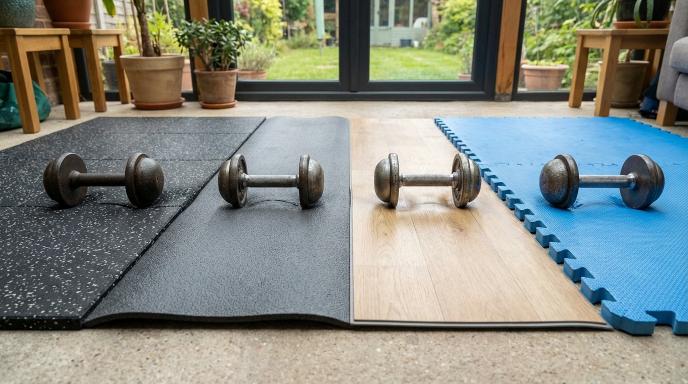
High-Density SBR Rubber is the industry standard for London garden gym builds. SBR (Styrene-Butadiene Rubber) tiles at 20mm to 40mm thickness provide excellent vibration damping, are non-slip when wet, and are virtually indestructible. In a bespoke garden room, 30mm tiles provide enough mass to prevent a treadmill at full speed from vibrating the structure and stressing the glazing.
EPDM-topped tiles are the aesthetic choice for high-end gyms in Richmond or Hampstead. The EPDM surface layer is denser and easier to clean than standard SBR, and the flecked colour options suit a premium interior. Ensure tiles are cold-pressed — this manufacturing process prevents the rubber from shedding or producing the tyre-factory odour common in poorly ventilated garden rooms.
Luxury Vinyl Tiles (LVT) suit hybrid rooms used as a gym by day and an office or studio in the evening. LVT has zero impact resistance on its own — a dropped dumbbell will crack the tile. The correct specification is LVT laid over a 10mm high-density impact underlay, which protects the sub-floor and provides the necessary acoustic damping.
Sub-Floor Preparation: The Invisible Support
The most expensive rubber mat available is worthless if the timber sub-floor beneath it is inadequate. Standard garden rooms use floor joists spaced at 400mm centres. For a gym, 300mm centres are recommended, with doubled joists beneath the static position of any heavy rack or platform. For the decking material, 22mm tongue-and-groove P5 moisture-resistant chipboard or marine-grade plywood is the correct specification. Standard 18mm OSB/3 has too much flex for heavy lifting, causing rubber tiles to shift and gap over time.
Because garden rooms sit above ground on a ventilated base, moisture management is critical. A vapour barrier must be laid beneath the gym floor to prevent condensation forming between the rubber and the timber. Rubber is impermeable — if moisture is trapped under gym mats, sub-floor rot can develop within three years. Channelled rubber tiles that allow air to circulate beneath the matting are strongly preferred in 2026 builds.
Acoustic Decoupling: Keeping the Peace in London
London gardens are acoustic environments where impact noise travels efficiently through lightweight timber structures. When a heavy weight is dropped on a timber-framed floor, the sound travels not just downward but outward through the walls. The solution is a floating floor using acoustic cradles — rubber feet positioned beneath the floor joists that lift the entire floor assembly away from the building's main frame. This absorbs the kinetic energy of a dropped weight before it can turn the garden room into a resonating drum.
Thermal Considerations: Expansion and Contraction
Rubber expands and contracts significantly with temperature change. London temperatures can swing from below zero in winter to over 35°C in summer. Wall-to-wall tight fitting without an expansion gap will cause tiles to buckle or peak in summer heat. An expansion gap of 5 to 8mm at all perimeters is the correct installation standard.
Underfloor heating can be used beneath gym rubber, but only with thin-profile electric mats. Thick 40mm rubber is a powerful insulator — placing UFH beneath it means the heat cannot reach the room, and the cables risk overheating. Infrared panel heaters are a more practical heating solution for a heavily floored garden gym.
Air Quality and VOC Compliance
In a compact garden gym, air quality is as important as flooring specification. Cheap rubber mats off-gas Volatile Organic Compounds — breathing these in at an elevated heart rate is not acceptable. In 2026, specify only Low-VOC or REACH-compliant flooring from a verified supplier. For hygiene, closed-cell rubber or an EPDM surface finish can be sanitised with a standard mop and non-acidic cleaner, unlike open-textured mats that trap sweat and debris.
Flooring Specification Summary
- Yoga and mobility: 10mm EVA foam or cork — Shore A 30 to 45
- Cardio and HIIT: 15mm SBR rubber or LVT with 10mm impact underlay — Shore A 55 to 65
- Free weights up to 20kg: 20mm high-density SBR tiles — Shore A 65 to 75
- Heavy powerlifting: 30mm to 40mm EPDM-topped rubber over a floating floor system — Shore A 75 to 90
- All gym builds: P5 chipboard or marine plywood sub-floor, vapour barrier, expansion gaps at all perimeters, REACH-compliant rubber
Conclusion
A garden gym is a high-performance environment that places extreme demands on its flooring. By investing in the correct Shore A hardness for your training style, specifying a properly braced sub-floor with a vapour barrier, and decoupling the floor acoustically, you create a facility that protects the building, respects your neighbours, and performs at a professional level for decades. View our garden gym range for specifications and pricing.
Written by
LGR
Editorial Team
London Garden Rooms publishes general guidance to help homeowners prepare project questions. Check planning, technical and pricing details for your own property with the relevant professional.