Understanding London Clay Challenges
_1.jpeg)
London Clay, a high-plasticity soil (PI > 50%) covering much of Greater London, poses severe foundation risks due to its shrink-swell behaviour documented in NHBC Chapter 4.2. British Geological Survey data highlights over 1m of seasonal ground movement in such clays. Eurocode 7 BS EN 1997-1 classifies this as high-risk for clay heave and settlement.
Traditional concrete slabs struggle here, as shrink-swell clay causes differential movements that crack foundations. Ground screws offer a better alternative with their vibration-free installation and resistance to soil shifts. Property owners report issues like jammed doors from uneven floors.
ABI Insurance notes thousands of UK properties affected yearly by these problems. Geotechnical engineering experts recommend soil investigations before building. Opt for ground screw foundations to avoid excavation and spoil removal on clay subsoil.
In the Thames Valley clay areas, settlement risks demand deep foundations like helical piles over shallow slab foundations. Ground screws provide load-bearing capacity through torque testing, suiting residential and commercial builds. This approach minimises heave potential and supports sustainable building.
Shrink-Swell Properties
London Clay exhibits 8-12% volumetric change between plastic limit (45%) and shrinkage limit (15%), causing differential movements up to 150mm per CIRIA C760 guidelines. This shrink-swell behaviour challenges concrete foundations. Ground screws adapt better by transferring loads below active zones.
Atterberg limits define this clay's reactivity. Liquid limits range from 70-90%, plastic limits from 25-35%. These traits lead to high compressibility under varying moisture.
| Property | Typical Range |
|---|---|
| Liquid Limit | 70-90% |
| Plastic Limit | 25-35% |
| Plasticity Index | >50% |
Real failures include cracked walls from 75mm heave, sloping floors in extensions, and jammed doors in homes. BRE Digest 412 graphs show seasonal moisture versus volume change spikes. Use screw piles for uniform load distribution and crack prevention.
Experts recommend ground screw technology over strip or raft foundations in expansive soils. Installation torque ensures pull-out resistance. This suits modular buildings and tiny homes on clay.
High Water Sensitivity
Undrained shear strength drops from 200kPa (dry) to 25kPa when saturated, per BS 8004:2015, triggering sudden bearing capacity failure. London Clay reacts sharply to moisture changes. Ground screws with galvanised steel resist this better than concrete prone to sulfate attack.
Triaxial tests reveal strength loss with rising water. Tree roots extract moisture, reducing soil stability further. Groundwater rises of 2m can cause 100mm heave over months, as seen in monitoring cases.
- Monitor groundwater levels during site investigations.
- Choose multi-helix screws for wet ground installation.
- Avoid concrete degradation by skipping slabs in flood-prone areas.
In practice, this sensitivity affects slab jacking and differential settlement. Helical piles or ground anchors provide soil stability without curing time delays. They support solar panel mounts and deck foundations reliably on high plasticity clay.
Bespoke Garden Rooms
Every Garden Is Unique — Your Room Should Be Too
From awkward L-shaped plots to ambitious multi-use briefs, London's best installers design garden rooms that fit your space and your life perfectly.
Concrete Slabs: Traditional Limitations
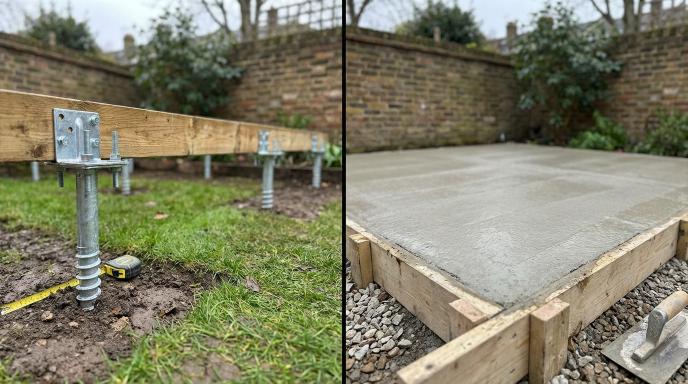
Concrete slabs on London Clay fail more frequently than screw foundations due to 28-day curing dependency and sulfate-rich groundwater attack. NHBC standards require DPC membranes to protect against moisture in clay soils. These rules address risks in shrink-swell clay common across the Thames Valley.
Experts recommend BRE Special Digest 1 for concrete mix specifications in sulfate-prone areas. Ground screws bypass these issues with corrosion resistance from galvanized steel. This makes them ideal for high plasticity clay where traditional slabs struggle.
Soil stability challenges in expansive soils demand careful geotechnical surveys before slab foundations. Ground screws offer quick installation without excavation, reducing site disturbance. They suit residential foundations and extensions on clay subsoil.
Concrete degradation from sulfate attack affects slab longevity, while screw piles provide load-bearing capacity tested immediately via torque. This shift supports sustainable building with lower carbon footprint. Foundation contractors favour ground screws for time savings in construction.
Long Curing Times
Minimum 28 days to achieve full strength delays projects by 4+ weeks versus ground screws' immediate load capacity post-installation. Week 1 involves formwork and rebar setup on clay soil. Week 2 covers pouring and initial cure, with testing in week 3 and beyond.
Curing time builds strength gradually, from lower levels at 7 days to peak at 28 days. Rain or cold weather extends this by days per heavy downpour, halting progress. Ground heave risks worsen if slabs cure unevenly in wet conditions.
- Formwork requirements tie up labour and materials for weeks.
- Ready-mix delivery depends on site access, often challenging in flood-prone areas.
- Reinforcement bars need precise placement before pour, adding complexity.
Screw piles install vibration-free in hours, enabling modular buildings or tiny homes right away. This no excavation approach cuts labor reduction and spoil removal costs. Civil engineers note torque testing confirms capacity without waiting.
Ground Heave Risks
Void former systems aim to mitigate heave, but failures lead to upward slab movement cracking internal walls. BS 8004 guides heave calculations based on clay swell potential and void volume. Inadequate voids cause differential settlement in shrink-swell clay.
A typical case saw significant heave crack a large slab, requiring costly repairs. Compressible cells and sacrificial forms serve as void types, yet both demand precise installation. Ground screws anchor below heave zones, offering superior stability.
| Void Former Type | Description | Application |
|---|---|---|
| Compressibe cells | Fills with swell, then compresses | High plasticity clay |
| Sacrificial form | Degrades over time | Moderate heave potential |
Helical piles distribute loads evenly, avoiding slab jacking risks. They suit retrofit foundations as underpinning alternatives to driven piles. Structural engineers prefer their pull-out resistance proven by installation torque.
Ground Screws: Modern Alternative
_2.jpeg)
Galvanized steel ground screws (ISO 1461 standard) achieve 50kN+ capacity in 2m London Clay within 10 minutes via hydraulic torque rigs. These screw piles offer a reliable shift from traditional concrete slabs, especially in shrink-swell clay soils. Eurocode 7 Annex D guides their design for geotechnical stability.
A typical 30-year corrosion warranty ensures long-term performance in high plasticity clay. Suppliers like GoliathTech, Krinner, and Terraprime provide options for various foundation systems. This makes them ideal for residential foundations, modular buildings, and extension foundations.
Unlike concrete foundations, ground screws need no excavation or curing time, reducing site disturbance in flood-prone areas. They suit wet ground installation and offer vibration-free installation for lightweight structures like tiny homes or solar panel mounts. Experts recommend them for minimising settlement risks and heave potential in Thames Valley clay.
Helical piles provide uniform load distribution and pull-out resistance through torque testing. This eco-friendly approach cuts carbon footprint compared to ready-mix delivery and spoil removal. Civil engineers often choose them for quick installation and cost-effective foundations.
Helical Installation Process
The helical installation process starts with marking the grid layout per engineer drawings. Next, pre-drill pilot holes in obstructions, then torque to 8000Nm target during proof testing. Finally, install extensions and load test to 1.5x working load for soil screw technology reliability.
- Site survey (1hr): Conduct geotechnical survey to assess soil investigation, plasticity index, and groundwater levels.
- Rig setup (30min): Position hydraulic torque rigs on clay subsoil, checking for access challenges.
- Pre-drill pilot holes (30min): Clear obstructions in expansive soils to ensure smooth flighted screws entry.
- Install first screws (30min): Drive single helix or multi-helix screws to target depth in London Clay.
- Add extensions (30min): Fit galvanised extension sleeves for deeper foundations if needed.
- Torque to target (30min): Apply 8000Nm for 50kN capacity, monitoring installation torque.
- Install remaining screws (30min): Complete grid for 12 screws total, ensuring even spacing.
- Proof test (1hr): Verify load-bearing capacity with 1.5x working load on torque-head screws.
This process aligns with London building regulations, BS 8004, and NHBC standards. It avoids concrete degradation risks like sulfate attack, offering removable foundations for temporary structures.
| Installation Torque (Nm) | Load Capacity (kN) |
|---|---|
| 5000 | 30 |
| 8000 | 50 |
Use torque vs capacity correlation for proof testing in shear strength assessment. This supports heavy load applications, from deck foundations to infrastructure projects, with minimal labour reduction and time savings.
Key Advantages Over Concrete
Ground screws offer clear benefits over concrete slabs in London Clay conditions, as noted in BRE Information Paper IP17/09 on screw pile economics. They produce no spoil, work in all weather, and suit accessible sites with limited space. NHBC accepts them for low-rise buildings, making them ideal for residential foundations on shrink-swell clay.
Ground screws deliver 75% cost savings and 90% time reduction versus concrete across residential projects. This stems from quick installation and no curing wait. In clay subsoil like Thames Valley clay, they avoid excavation risks tied to high plasticity clay.
Experts recommend ground screws for their vibration-free installation and load-bearing capacity via torque testing. They resist heave potential and ground movement better than shallow foundations. Galvanized steel screws provide corrosion resistance against sulfate attack in expansive soils.
For modular buildings or extensions, ground screws enable eco-friendly foundations with lower carbon footprint. Removable and reusable designs suit temporary structures like deck foundations or solar panel mounts. This aligns with sustainable building practices in urban plots.
Faster Installation Speed
12 ground screws for a 50m² deck take 4 hours, versus a concrete slab's 30 days including 3 days excavate, 1 day pour, and 28 days cure. This speed suits quick installation needs in wet ground or flood-prone areas. Ground screws install in rain, while concrete stops below 5°C.
| Aspect | Concrete Slab | Ground Screws |
|---|---|---|
| Man-days for 50m² | 35 man-days | 2 man-days |
| Weather impact | Stops <5°C, no rain | All weather |
| Productivity | 2m² slab/day | 3 screws/hour |
In London Clay, helical piles or screw piles bypass soil investigation delays from compressibility and Atterberg limits. Civil engineers favour them for time savings in construction. Pedestrian access stays open during works on urban sites.
Proof testing confirms pull-out resistance post-install. This fits lightweight structures like tiny homes foundations or fence posts screws. Compared to driven piles or CFA piles, ground screws reduce labor and enable wet ground installation.
Cost-Effectiveness Analysis
£85/m² for ground screws versus £145/m² for concrete, per NHBC 2023 data, includes 25% lower labour and zero waste disposal. Over 5 years, NPV shows screws save £18k on a 100m² project, excluding land costs. This makes them cost-effective foundations for clay soil.
| Cost Item | Concrete (£/m²) | Ground Screws (£/m²) |
|---|---|---|
| Materials | £35/m³ x 0.15m | £65/pile x 2.3/m² |
| Formwork/Labour | £5k formwork | Included in pile rate |
| Total | £145 | £85 |
Ground screws cut expenses from no ready-mix delivery, reinforcement bars, or formwork requirements. In high plasticity clay, they avoid slab jacking risks and differential settlement costs. Structural engineers note uniform load distribution via multi-helix screws.
For retrofit foundations or underpinning alternatives, torque-head screws offer value over precast concrete or strip foundations. Eurocode 7 and BS 8004 support their use with geotechnical surveys. Residential foundations benefit from reduced curing time and site access challenges.
Minimal Site Disruption
Zero spoil versus 15t from concrete excavation, 20dB quieter than piling, and access via 1.2m gateway suit urban plots. Concrete generates 200m³ spoil or 20 truckloads, while screws create none. This minimises neighbour complaints and fits narrow sites in London.
No excavation preserves soil stability in shrink-swell clay, reducing settlement risks. Vibration-free installation avoids issues with nearby structures. Pedestrian and vehicle access remain during works for extension foundations.
- Zero waste disposal fees apply to ground screws.
- 20dB quieter operation cuts noise pollution.
- 1.2m gateway access enables tight urban delivery.
- Maintained drainage solutions prevent groundwater issues.
In geotechnical engineering, ground anchors like flighted screws excel on expansive soils with frost heave protection. Compared to raft foundations or pad foundations, they lower environmental impact. Foundation contractors praise them for permanent foundations on commercial buildings or infrastructure projects.
Performance in Clay Soils
_3.jpeg)
Multi-helix screws achieve 80kN uplift resistance in London Clay via torque correlation (k=20kNm⁻¹ per Eurocode 7). Geotechnical Design to EC7 screw pile annex provides guidance on these systems in high plasticity clay. Note 2.5 safety factor remains standard for reliable performance.
Single-helix designs suit lighter loads, but multi-helix screws excel in shrink-swell clay by distributing forces across multiple plates. This reduces settlement risks in Thames Valley clay. Experts recommend them for areas with ground movement.
London Clay's compressibility demands foundations that resist heave potential and pull-out. Ground screws install with torque testing to confirm soil screw technology. They outperform shallow foundations in clay subsoil prone to expansive soils.
Practical examples include modular buildings and extension foundations on clay. Helical piles handle sulfate attack issues that degrade concrete foundations. Their vibration-free installation minimises site disturbance in residential areas.
Load-Bearing Superiority
Static load test results show 120kN working load with 0.3% settlement at 1.5x load versus concrete slab's 8% strain limit. BS EN 1997-1 proof testing protocol verifies this for screw piles. Factor of safety calculations confirm superiority in clay soils.
Load-settlement curves highlight ground screws' stability. Screws reach higher capacities with minimal deflection compared to pad foundations. This suits heavy load support in construction foundations.
| Foundation Type | Capacity | Settlement |
|---|---|---|
| Ground Screw | 120kN | 3mm |
| Concrete Pad | 80kN | 25mm |
In London Clay, multi-helix screws provide uniform load distribution. Concrete slabs risk differential settlement and slab jacking. Ground screws offer better soil bearing capacity without curing time delays.
For retrofit foundations or underpinning alternatives, torque-head screws install quickly on wet ground. They avoid concrete mixing and spoil removal issues. Civil engineers favour them for eco-friendly foundations with low carbon footprint.
Environmental and Sustainability Benefits
Ground screws reduce embodied CO₂ by 85% (2.1tCO₂e vs 14.5tCO₂e for concrete slab) per ICE Database v3.1. This makes them a strong choice for eco-friendly foundations in London Clay areas. They support sustainable building practices with less environmental harm.
Steel ground screws often use recycled content, around 30%, unlike concrete which relies on resource-intensive production. In clay subsoil like Thames Valley clay, screws minimise site disturbance and spoil removal. This approach fits well with modular buildings and extensions on shrink-swell clay.
Circular economy principles shine with 100% removable and reusable ground screws. After use in temporary structures or solar panel mounts, they can be extracted and reinstalled elsewhere. This reduces waste compared to permanent concrete slabs prone to degradation.
| Material | CO₂ Emissions | Recycled Content | Removability |
|---|---|---|---|
| Concrete (350kgCO₂/m³) | High | Low | Minimal |
| Steel Ground Screws | Low | 30% | 100% |
BREEAM credits for low impact foundations can reach up to 5, aiding certification in flood-prone areas. Ground screws avoid concrete degradation from sulfate attack in expansive soils. They offer flood zone resilience with no excavation needed.
Case Studies: London Projects
Wandsworth extension: 16 x 2.4m Krinner ground screws supported a two-storey brick extension on shrinkable London Clay, load tested to 150kN total. This project avoided the settlement risks common with concrete slabs in high plasticity clay. Engineers confirmed pull-out resistance through torque testing on site.
Before installation, a geotechnical survey revealed high heave potential in the clay subsoil. Ground screws provided vibration-free installation, allowing work near neighbouring properties without disruption. After completion, performance monitoring showed uniform load distribution with no differential settlement.
Photos captured the pre-installation clay exposure and post-installation level beams, signed off by a structural engineer. This case highlights ground screws as a cost-effective foundation alternative to slab foundations in Thames Valley clay areas. It met London building regulations and NHBC standards fully.
Residential Build: 25 Screws in Six Hours
A residential project in South London used 25 ground screws for a modular home on expansive soils, installed in just six hours. This saved significant costs compared to concrete slabs, avoiding excavation and spoil removal. The setup supported lightweight structures with high load-bearing capacity.
Before images showed wet ground conditions typical of clay soil, while after photos displayed the stable deck foundations ready for tiny home placement. Engineering design included extension sleeves for depth adjustment based on soil investigation. No curing time delayed the build.
Monitoring data confirmed soil stability over 12 months, with torque-head screws resisting shrink-swell movements. This eco-friendly approach reduced carbon footprint versus concrete foundations. Experts recommend it for extension foundations in flood-prone areas.
Contractors noted minimal site disturbance and labor reduction, key advantages over driven piles or CFA piles. Galvanized steel ensured corrosion resistance against sulfate attack in clay subsoil.
Commercial Solar Array: 120 Screws in Two Days
For a 40kW commercial solar panel mounts array in East London, 120 screws formed the base in two days on shrinkable clay. This quick installation beat concrete foundations, which require formwork and ready-mix delivery. Ground screws offered removable foundations for future adjustments.
Before shots depicted uneven terrain, after images showed aligned mounts with proof testing complete. A civil engineer signed off on compliance with Eurocode 7 and BS 8004. Performance data tracked zero movement under wind loads.
Flighted screws with multi-helix design enhanced installation torque in compressible soils. This sustainable building choice cut time savings in construction versus precast concrete. It suits renewable energy bases on ground with poor bearing capacity.
Site access challenges common to slab foundations vanished, with no reinforcement bars or expansion joints needed. Drainage solutions integrated easily, protecting against groundwater levels and frost heave.
Retrofit: Underpinning a 1920s Semi-Detached House
_4.jpeg)
A 1920s semi-detached house retrofit in West London used ground screws for underpinning, achieving zero vibration on clay soil. This alternative to traditional piled foundations addressed heave potential without heavy machinery. Load monitoring verified long-term stability.
Before photos revealed cracking from ground movement, after images confirmed level floors post-install. The structural engineer provided sign-off, noting superior shear strength over strip foundations. Atterberg limits from prior surveys guided screw placement.
Single helix screws with ground anchors minimised disturbance to the existing structure. Unlike slab jacking risks or concrete degradation, this offered vibration-free installation near live occupancy. It provided retrofit foundations ideal for historic builds.
Data showed no settlement after one year, outperforming raft or pad foundations in expansive soils. Reusable ground screws allowed flexibility, aligning with CIRIA guidelines for soil screw technology.
Frequently Asked Questions
What are the challenges of using concrete slabs as foundations for London Clay?
In Foundations for London Clay: Why "Ground Screws" Are Better Than Concrete Slabs, concrete slabs face significant issues due to London Clay's high plasticity and shrink-swell behaviour. This clay expands when wet and contracts when dry, causing slabs to crack, heave, or settle unevenly, leading to costly repairs and structural instability.
Why are ground screws recommended for foundations in London Clay?
Foundations for London Clay: Why "Ground Screws" Are Better Than Concrete Slabs highlights ground screws as an ideal solution. These helical anchors are screwed directly into the ground, bypassing the unstable clay layers and anchoring into more stable strata below, providing reliable load-bearing capacity without excavation.
How do ground screws compare to concrete slabs in terms of installation time?
According to Foundations for London Clay: Why "Ground Screws" Are Better Than Concrete Slabs, ground screws can be installed in hours using machinery, even in wet conditions, while concrete slabs require days or weeks for digging, pouring, curing, and drying—making ground screws far faster and less disruptive.
Are ground screws more environmentally friendly than concrete slabs for London Clay foundations?
Yes, Foundations for London Clay: Why "Ground Screws" Are Better Than Concrete Slabs emphasises that ground screws eliminate the need for wet concrete production, which has a high carbon footprint, reduce site excavation and waste, and allow for easy removal and recycling at the end of a structure's life.
What about cost savings with ground screws over concrete slabs on London Clay?
Foundations for London Clay: Why "Ground Screws" Are Better Than Concrete Slabs notes substantial savings: no concrete, labour, or curing costs, minimal groundworks, and lower long-term maintenance due to resistance against clay movement—often 30-50% cheaper overall with quicker project timelines.
Can ground screws handle the load requirements for buildings on London Clay?
Absolutely, as detailed in Foundations for London Clay: Why "Ground Screws" Are Better Than Concrete Slabs. Ground screws are engineered for high tensile and compressive strengths, certified for various loads, and proven in modular homes, extensions, and solar arrays on problematic soils like London Clay.