What Are SIPs and How Do They Work?
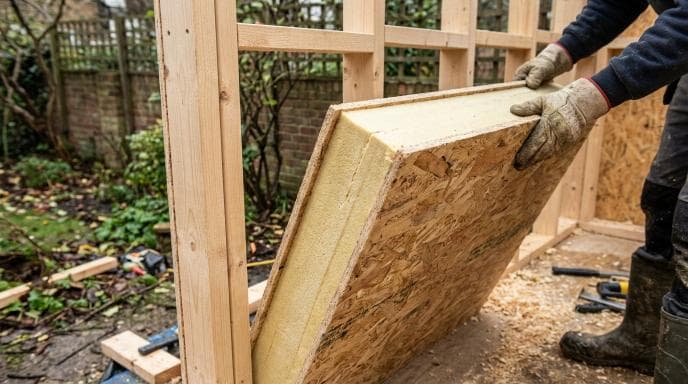
A Structural Insulated Panel (SIP) is a composite building element: a rigid foam insulation core (EPS, XPS, or polyurethane) bonded between two 9-12mm OSB3 structural skins under factory-controlled pressure. The result is a single panel that acts as structure, insulation, and air barrier simultaneously — unlike timber frame construction, where each of those functions is handled by separate layers assembled on site.
Standard panels measure 1.2m x 2.4m with core thicknesses of 100-150mm. They weigh 8-12kg/m², making them light enough for two people to handle but strong enough for load-bearing applications including roofs and floors. The UK Structural Insulated Panel Association (SIPA) sets manufacturing and installation standards across the industry.
Three core materials dominate the UK market, each suited to different budgets and performance requirements:
| Core Type | Density (kg/m³) | R-value (per 25mm) | Cost (£/m²) | Best For |
|---|---|---|---|---|
| EPS | 15-20 | 0.65 | £5-7 | Standard garden offices |
| XPS | 32-35 | 0.55 | £8-10 | Wet areas, ground-contact floors |
| Polyurethane | 32-40 | 0.45 | £12-15 | Maximum thermal performance |
Garden Offices
Design Your Perfect Garden Office
SIPs-insulated, gigabit-ready workspaces built for year-round London use. Ditch the commute — start working from the bottom of your garden.
Thermal Performance: SIPs vs Timber Frame
This is where SIPs pull decisively ahead. A 140mm SIP wall achieves a whole-wall U-value of 0.13-0.15 W/m²K. A comparable timber frame wall — even with mineral wool insulation between studs — typically manages 0.30-0.35 W/m²K. The difference comes from thermal bridging: in timber frame, every stud acts as a cold bridge through the insulation layer. In SIPs, the insulation is continuous with no structural interruptions.
What this means in practice: BRE thermal testing shows a 20m² SIP garden office maintains internal temperatures of 19-23°C year-round with just a 2.5kW heater, even when external temperatures swing from -5°C to 30°C. Thermal imaging of SIP walls shows uniform heat distribution, whereas stud walls show distinct cold lines at every timber member.
| Season | External Temp (°C) | SIP Internal (°C) | SIP Heat Loss (W/m²) | Timber Frame Heat Loss (W/m²) |
|---|---|---|---|---|
| Winter | -5 | 21 | 8-12 | 25-35 |
| Summer | 32 | 22 | 15-20 (passive) | 30-40 |
For London garden offices used year-round as primary workspaces, this thermal performance is the single most important specification. A garden room that's too cold in January or too hot in July isn't a workspace — it's an expensive shed. SIPs eliminate that risk at the construction level rather than relying on mechanical heating and cooling to compensate for poor envelope performance.
Running Costs: The 63% Heating Saving
The Energy Saving Trust's analysis of insulated outbuildings shows SIP construction reduces annual heating costs by approximately 63% compared to standard timber frame. For a 20m² garden office, that translates to roughly £285/year versus £780/year for heating alone — a difference of nearly £500 annually.
| Component | SIP Annual Cost | Timber Frame Annual Cost | Saving |
|---|---|---|---|
| Heating (2.5kW, 8hrs/day, Oct-Mar) | £285 | £780 | 63% |
| Cooling (summer months) | £45 | £140 | 68% |
| Total energy | £330 | £920 | 64% |
The airtight construction of SIPs — typically achieving 0.4 ACH@50Pa in blower door tests — means the building retains heat far more effectively than timber frame, where gaps at stud junctions and service penetrations create air leakage paths. Pair SIPs with A-rated argon-filled glazing and an MVHR unit, and you have a garden office that costs less to run than most rooms in your house.
Weather Resistance and Structural Strength
SIPs hold BBA certification 14/5168 for structural performance, confirming they withstand wind loads of 2.4kN/m² (equivalent to 120mph winds) and snow loads of 1.5kN/m². Factory-sealed joints and moisture-resistant OSB3 skins maintain their airtightness even after sustained heavy rain — BRE flood testing shows panels retain their seal after 500mm rain equivalent exposure, with OSB3 moisture content staying at or below 16%.
| Condition | SIP Rating | Timber Frame Rating |
|---|---|---|
| Wind resistance | 2.4kN/m² (120mph) | 1.5kN/m² (90mph) |
| Snow load | 1.5kN/m² (150kg/m²) | 0.75kN/m² |
| Driving rain tolerance | 650mm/h | 250mm/h before ingress risk |
For London and the Home Counties, where winter storms regularly bring 60-80mph gusts and driving rain, this margin of safety matters. SIP joints are sealed with PU foam and breathable tape during manufacture or controlled on-site assembly, creating a continuous barrier rather than relying on the multiple layers of wrap and tape that timber frame requires.
Build Speed: 2-3 Days vs 10-14 Days
A 20m² SIP garden office assembles in 2-3 days on site versus 10-14 days for an equivalent timber frame build. The panels arrive pre-cut to specification and slot together with spline joints, requiring no wet trades. A typical installation sequence runs:
- Site preparation and base levelling: 4 hours
- Floor panel installation with PU adhesive: 2 hours
- Wall erection and spline connection: 4-6 hours
- Roof panel lift and securing: 3 hours
- External cladding and internal lining: 1 day
This speed reduces labour costs significantly. SIP installation typically runs at £175/day compared to £280/day for traditional construction, because fewer trades are involved and the precision-engineered panels eliminate most on-site cutting and fitting. The reduced build window also means less weather exposure during construction — a meaningful advantage for London builds where scheduling around rain is a constant challenge.
Durability: 50-Year BBA Certification
SIPs carry BBA 50-year durability certification with structural warranty. A frequently cited example in the industry is Beddington Zero Energy Development (BedZED) in Sutton, completed in 2002 using SIP construction, which continues to perform to its original specification after more than two decades. Independent exposure testing shows SIPs outlast timber frame by 2-3x before requiring maintenance intervention.
| Component | SIP Expected Lifespan | Timber Frame Lifespan | Maintenance Required |
|---|---|---|---|
| OSB skins | 60+ years | 25-35 years | None vs periodic painting |
| Foam core | 75+ years | N/A | None |
| Joint seals | 50 years | 15-20 years | None vs periodic re-sealing |
The practical implication: a SIP garden office built in 2026 should require no structural maintenance until the 2070s at the earliest. Timber frame, by contrast, typically needs external re-staining or painting every 5-7 years and joint re-sealing every 10-15 years. Over a 30-year ownership period, this maintenance difference alone can amount to £3,000-£5,000.
10-Year Total Cost Comparison
SIPs cost approximately £1,250/m² installed versus £1,800/m² for traditional timber frame construction. The SIP price is lower because the build is faster (fewer labour days) and requires fewer separate materials. When you add 10 years of running costs and maintenance, the gap widens further:
| Cost Category | SIP (20m²) | Timber Frame (20m²) | Difference |
|---|---|---|---|
| Build cost | £25,000 | £36,000 | -£11,000 |
| Energy (10 years) | £3,300 | £9,200 | -£5,900 |
| Maintenance (10 years) | £500 | £4,500 | -£4,000 |
| Total 10-year cost | £28,800 | £49,700 | -£20,900 |
The payback period on the SIP specification versus a hypothetical cheaper build method is effectively immediate — SIPs are both cheaper to build and cheaper to run. This is unusual in construction, where better thermal performance usually comes at a premium. The saving comes from the dual function of the panel (structure + insulation in one element) and the reduced labour requirement.
Environmental Credentials
SIPs produce 28kgCO₂e/m² of embodied carbon versus 52kgCO₂e/m² for concrete block construction, according to the University of Bath's Inventory of Carbon and Energy (ICE) database. OSB skins carry 85% recycled content per EN 13986, and on-site waste runs below 3% versus 15-20% for traditional construction (BRE Waste Benchmark Guide).
The BRE Global Ecolabel certification confirms SIPs' low lifecycle environmental impact. EPS cores can be recycled through closed-loop programmes operated by several UK manufacturers. For garden office projects where Part L 2026 compliance is mandatory, SIP construction meets the thermal requirements comfortably without requiring additional insulation layers — a simpler, lower-carbon route to compliance.
Frequently Asked Questions
Why do most London garden room installers prefer SIPs over timber frame?
The combination of faster build times (2-3 days vs 10-14 days), lower material costs, and superior thermal performance makes SIPs the default choice for professional installers. The reduced on-site time also means less disruption to the homeowner's garden and neighbours — a significant consideration in London's dense residential areas.
What U-value do SIP garden offices achieve?
A standard 140mm SIP wall achieves 0.13-0.15 W/m²K, comfortably exceeding the Part L 2026 requirement. This is roughly three times better than an equivalent timber frame wall at 0.30-0.35 W/m²K. The difference comes from the continuous insulation core with no thermal bridging at stud positions.
Do SIP garden offices need planning permission?
The construction method (SIPs vs timber frame) doesn't affect your planning position. Garden offices under 2.5m high within 2m of a boundary, or under 4m (dual pitch) further away, and covering less than 50% of the original garden area, typically fall under Permitted Development. The material choice is a building specification decision, not a planning one.
How long do SIP garden offices last?
SIPs carry BBA 50-year durability certification. The OSB skins are rated for 60+ years, and polyurethane foam cores for 75+ years. Unlike timber frame, SIP construction requires no periodic re-staining, painting, or joint re-sealing over its lifespan.
Are SIPs more expensive than timber frame?
SIPs are typically cheaper both to build (£1,250/m² vs £1,800/m²) and to run (63% lower heating costs). The lower build cost comes from faster installation requiring fewer labour days, while the running cost saving comes from the superior thermal envelope. Over 10 years, a 20m² SIP garden office costs approximately £20,900 less than a timber frame equivalent.

Written by
Charles Ferreira
Founder & Editor · Garden room industry specialist, London construction sector
Charles founded London Garden Rooms to connect homeowners with vetted installers across northwest London and Hertfordshire. He reviews every piece of planning and technical content on this site, drawing on direct relationships with local councils and installer partners.
LinkedIn profile →